

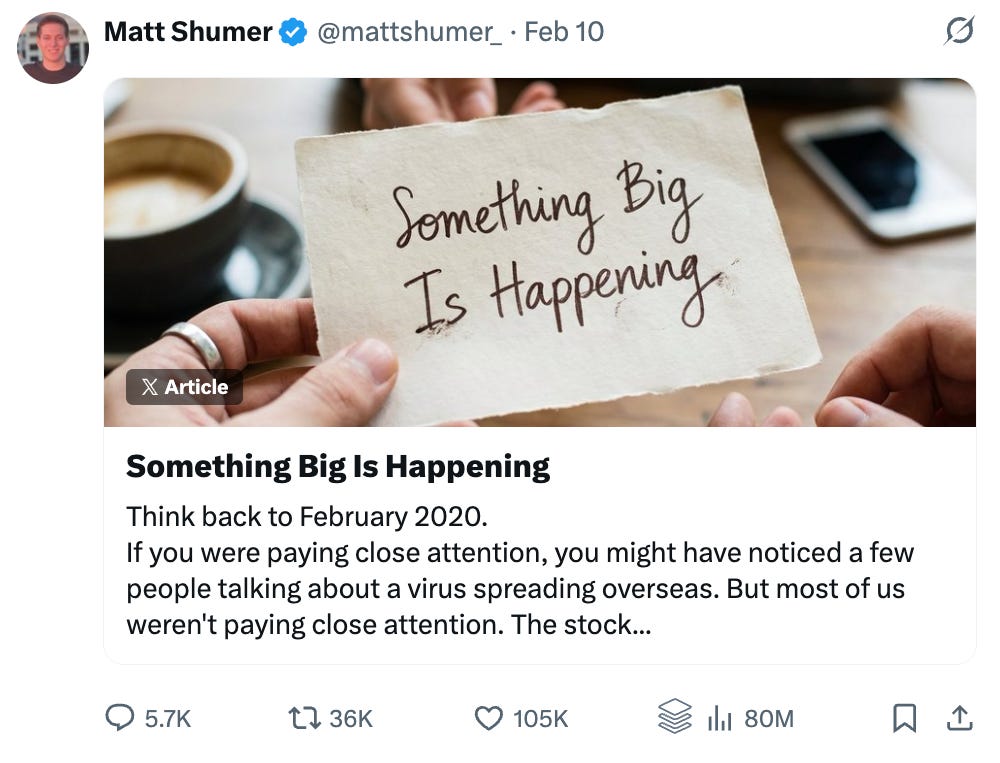
Earlier this week, a post about how AI is going to change everything—take our jobs, make traditional education irrelevant, and transform every facet of our lives—went viral. The post, which to be honest, I found pretty compelling, built toward a straightforward conclusion: if you aren’t already, you better start incorporating AI into just about everything you do, lest you’ll be left behind.
The author of the post, Matt Shumer, is CEO of an AI company. He certainly has an incentive to make his case. Not to mention, scarcity and fear have long been potent marketing tactics. But it’s not just Shumer.
Countless people who work in tech are sounding the alarm about the impending impact of AI. World-class software developers are saying AI can do nearly all of their work, and not just faster but better. In a recent earnings call, the music streamer Spotify said “it’s best developers haven’t written a line of code since December, thanks to AI.”
I have no reason to doubt any of these people. But it’s worth noting that much of the AI is changing everything chorus is coming from three specific camps:
Software developers, who work in what researchers call kind environments, meaning the variables are known and unchanging, and the work is repeatable and often relies upon binary logic. Chess is a kind environment. Surgery is not.
People who do process heavy work, such as filling out spreadsheets, translating reports to powerpoint, and so on.
Growth marketers, whose jobs are often contingent on quantity (reach as many people as possible) and not quality (produce extraordinary work).
I’m not here to argue that AI won’t be disruptive.
It seems there will be a lesser need for software developers. Countless bullshit jobs will be automated. (The late anthropologist David Graeber reasoned that at least 40 percent of jobs are bullshit.) The internet is already full of average content produced by AI bots (and people who have come to resemble AI bots). This will only get worse, and perhaps on an exponential scale, since the cost of producing content is only $20 per month (the fee for a starter Chat-GPT or Claude account). I find it hard to imagine AI will ever produce great writing, but I’m sure the generation before me found the internet hard to imagine too.
All of this is to say AI will have a profound impact on much of life for much of the population. But something AI won’t do is generate fulfillment.
And we desperately need fulfillment.
An Impending Epidemic of Emptiness
One of the most reader-highlighted passages in my new book, The Way of Excellence, goes like this: “The main reason I write and lift weights is because a technology company can’t design a robot that can make me feel what I feel when I write and lift weights. Maybe the robot can write more elegantly or lift more weight. But it can’t make me feel the aliveness of a great idea. It can’t make me feel the rhythm of a great sentence. It can’t make me feel the heavy-ass weight starting to move. This feeling is what makes us human. Find it in your own life. Protect it. Cherish it.”
The biggest disruption from AI that nobody is talking about is the emptiness and longing that accompanies an increasingly automated life. The feeling you gain from exerting effort on something you find meaningful will become increasingly rare, and increasingly important. It’s true for writing, making music, training in the gym, running marathons, building tables, painting, gardening, and forging human relationships.

Feelings of connectedness and intimacy—be it with a craft, another person, or oneself—come not from results but from the process, from the messiness and struggle of doing the work.
Imagine that with artificial intelligence you could click a few buttons and, within seconds, “compose” an award-winning- caliber piece of music. Would this bring you fulfillment? It’s doubtful. Even the best outcomes are meaningless if we don’t go through the process of creating them. It is precisely because we’ve got to master the difficult, face setbacks, and overcome challenges that makes the pursuit of excellence so powerful and satisfying.
If you can use AI to make parts of your life easier then by all means go for it. But you need to be careful that AI does not become the centerpiece of your work, your leisure, and your relationships.
While I agree with Matt Shumer that AI will be highly disruptive, my conclusion is largely the opposite. I’m not stressing about becoming an AI power-user; rather, I’m doubling down on aspiring toward genuine, human excellence.
Meaningful Effort
If you build a life around meaningful effort on things that make you feel alive, and if your work can help others discover those same feelings, then you are setting yourself up for success in a world that is seeping with AI.
There’s a chance the AI tools are not nearly as good as everyone says. If that’s the case, we’re in a big bubble, and that’s that. And if the tools are as good as everyone says—then it won’t be long before everyone is using them. If everyone is using them, then the world will coalesce around an average that is determined by the latest model of Chat GPT or Claude. It means there will always be room to be different, to do better than average work and to live a better than average life.
It follows that the real competitive advantage in a world of AI is to be decidedly human; to create human art, to play human sports, to build human relationships. While everyone else is content to pump bits and bytes into machines, aspiring toward human excellence will not only set you apart, but also yield aliveness and depth instead of numbness and longing.
P.s., The Way of Excellence is an instant New York Times, USA Today, and Publisher’s Weekly bestseller. If you enjoyed this post you’ll love it. Get a copy here.
Sure, but it’s hard to find the luxury of perusing a meaningful life work when you have lost your job, the source of your income, and AI makes work increasingly scarce for your skill set.
Gen AI is a giant averaging machine. Let us all strive to be well above average in the things that bring us joy, connection, and meaning. As you so often remind us, Brad, it's the striving that is the point. Mastery is the end result of the effort and AI will never replace that rich reward.