

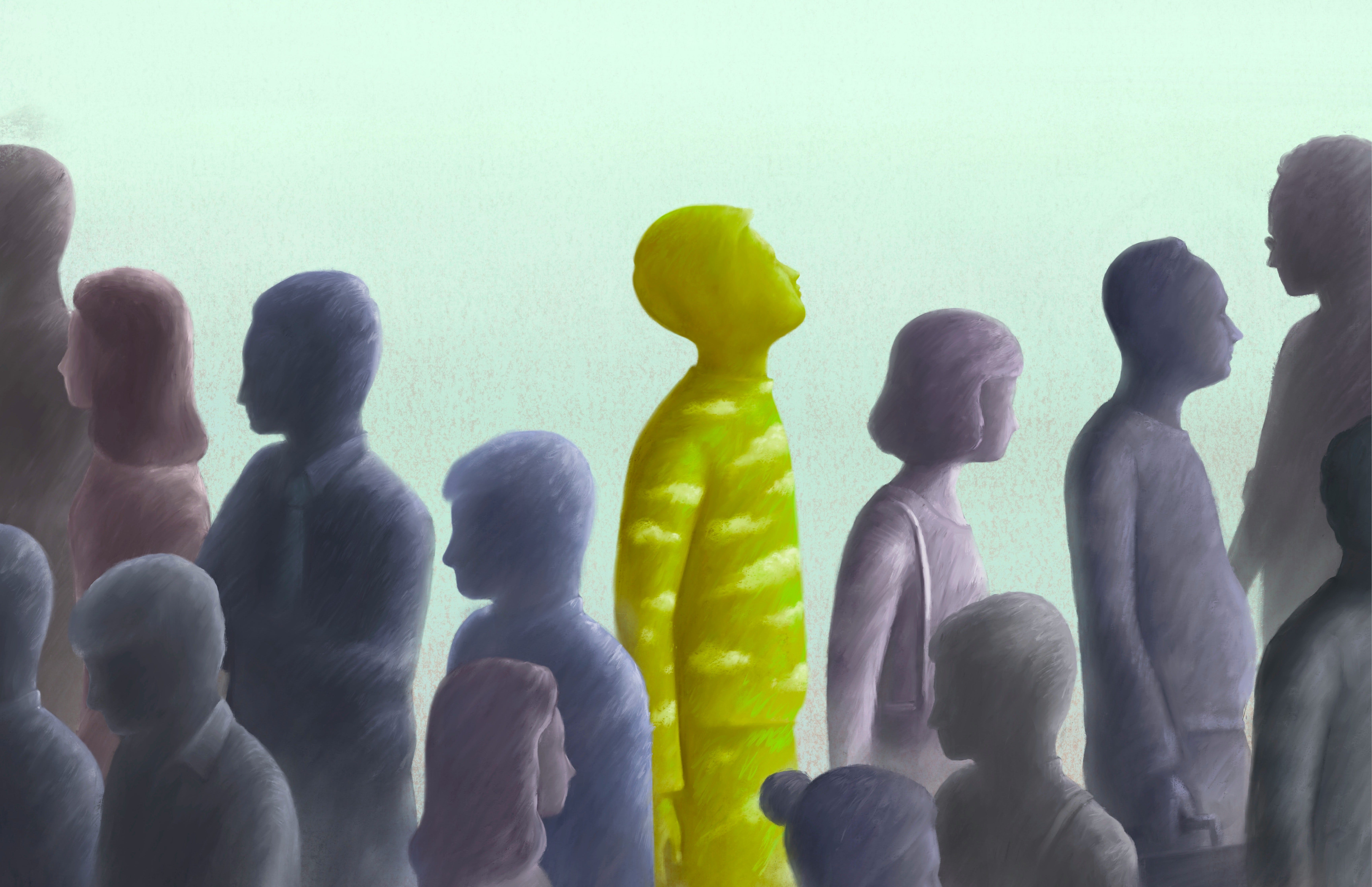
Over the past week, an international conversation has emerged about the dangers AI poses to humanity at a species level.
This is a good thing.
But it’s also important to consider perhaps the more imminent risk, which is what AI is already doing to our individual humanness. And it’s this risk I fear is being overlooked.
A new paper out of Harvard and the Santa Fe Institute likens AI to a “cognitive virus.” The researchers argue that while many people start using AI for trivial tasks, it finds a way to replicate itself in your brain. Since AI makes everything so much easier, you keep using it… until it starts using you. It gradually creeps into every corner of your life. You begin to think like it. You begin to speak like it. You begin to lose the skill of exerting effort itself.
Qualities such as struggle, resilience, effort, friction, accomplishment, satisfaction, and love are all big parts of what make life worth living. We shouldn’t give them up or outsource them to machines.
Which leads me to a recent conversation I had with Georgetown computer scientist, author extraordinaire, and one of my best friends, Cal Newport, for his podcast Deep Questions.
It turned out to be the most meaningful conversation I’ve had on what it means to pursue craft, quality, and excellence in an age of increasing automation, and how not to become a cynical Luddite, but also how to protect what makes you human.
So with Cal’s permission, I wanted to share a few highlights of the conversation with all of you, edited slightly for length and clarity.
If you want to get the entire conversation, you can watch on YouTube here or listen wherever you get your podcasts.
My AI Experience
Brad: So I started at this current position of minimal use, and then I had a conversation with someone whose work I respect a ton—this was about six or seven months ago–and they really encouraged me to use AI and essentially said, “Brad, I think your skepticism is starting to border on cynicism, and I think you’re missing the boat and a lot of the things...”
And at first, I tried it, and it was pretty good. I remember calling you Cal, and saying “Cal, maybe you’re being too much of a cynic here. Like, it’s giving me pretty good ideas.” And then about a month and a half in, what I realized is it gives me the same pretty good idea, over and over and over again.
I realized that it wasn’t making my work better. It wasn’t making my workflow better. So I said, “All right, I’m just going to use this as a copy editor. So, if I have a newsletter that I’m putting out or an essay that I’m working on, I’m just going to run it through the machine and tell it, “Please check for any grammatical and spelling errors.”
And it’s great. It catches all the grammatical and spelling errors. However, it just can’t resist adding in a little beat and saying, “Hey, if you want three ideas to punch it up, here’s what I’d suggest.” And the suggestions were pretty flat. And it kept recommending the same repetitive sentence structure for everything. Over time, it started to become really annoying.
Cal: Right. And you’re seeing this in the world of online content. You’re seeing quality degrading. You’re seeing the sharpness of ideas flattening. You’re seeing telltale signs of slop. I mean, every time I talk to you, you’re a little bit depressed about the state of online discourse. But for people out there who aren’t reading a lot online, what is it that you’re seeing happening around you by, you know, sort of our peer group of writers?
Brad: I’d argue it’s not serious writers but people who want to be writers without actually doing the work of writing, which are two separate things. But yeah, for them (which is tons of people on the internet, by the way) the writing is just completely homogenized and soulless.
I heard our mutual friend Derek Thompson put it this way: the AI robots feel like every sentence has to be more evocative than the last sentence. And that’s just not good writing. It’s weird synthetic writing.
So yes, I think that’s happening. And then another thing that is happening is that AI is degrading the experience of writing itself. Part of what makes for good writing is that someone struggled to produce it—because in that struggle, the best ideas come out. Clicking a button and picking and choosing what you want is not the same kind of struggle as actually writing.
The result of that is you can produce a lot more work, but the quality of the work goes down, and so too does the quality of your life, the quality of your experience with the craft.
I suspect this isn’t just for writing, but for pretty much everything you use AI with.
Three Planks of AI Use
1. Don’t let AI Degrade the Art of Exerting Effort
Cal: We were talking about this before on the phone; it really seemed like there were three major planks to your platform, and I think it’s worth looking at each of these in turn because we don’t normally hear this so systematically explored. Your first plank had to do with effort, right?
Brad: Yes. In order to find meaning in just about anything in life, whether it is a relationship, whether it is a work product, whether it is a leisure activity, you have to exert effort, and you have to struggle. Everything worthwhile in life requires effort.
By definition, the promise of AI is that it eliminates, mitigates, or shrinks effort. I call it the click-of-a-button economy. You want an essay, click a button. You want a recipe, click a button. You want a training plan, click a button. You want a script for asking someone out on a date, click a button. It eliminates the very struggle that leads to growth and feelings of satisfaction, whether you achieve or fail.
The common retort to this, which I totally sympathize with, is, “Well, if you’re just using AI for a few things, you can exert effort on other things.” And in theory, I think that’s great. But what happens is the more that you use AI, the more it’s a slippery slope. And gradually you’re like, “Oh, well, if it corrected all the grammar in my piece, maybe I’ll ask it to rewrite that paragraph that I was struggling with. And oh, if I asked it to rewrite that paragraph I was struggling with, maybe I’ll ask it for 10 different conclusions, and I’ll just choose the one I like best.”
And over time, it’s not you doing the work anymore. It’s the machine doing the work. And this isn’t some hidden secret. This is the very promise of AI.
But nobody wants their gravestone to read “He was efficient.”
Cal: Right. Well, I mean, an aspect of what you just said there is something I hadn’t thought about until I read this study where researchers said we can think about LLM use as a “cognitive virus.” And part of that construction was that we’re underestimating the addictiveness of this type of interaction, that it gradually replicates within us.
So, just like you were saying, “I’m just using an LLM to do X” is going to turn pretty soon into I’m using it for almost everything else because there is something that is irresistible about having a linguistic conversational partner that is listening to you, that is reflecting things back, that is largely telling you like, “This is good; what you’re doing is smart; let me do that for you.”
There’s a construction that especially the GPT models have where, if you’re asking for advice about anything, it will always say, “Yeah, that’s good. I like this a lot. There’s just one thing I would change.” And kind of constructive turns out to be the ideal way to give feedback to someone because it makes you feel smart, but it’s not just fully affirming, and it gives you that excitement of, like, ‘I have an idea that I just have to tweak a little bit, and this is really good’, and it is pretty addictive. And what that paper and you are helping me realize is that if you let this in one place, it’s going to spread to other places.
I like that you’re pushing on this a little bit because I think this is countercultural for a lot of people:
You’re saying struggle’s good, quality is good. You know, for a human to have experiences that are of quality. This seems to me like one of the big points in The Way of Excellence: that the pursuit of excellence is life-affirming, right? You’re saying struggle is good; quality is good. You know, for a human to have experiences that are quality.
Why have we been trained to think struggle or friction somehow means that something bad is happening?
Brad: I think there are a couple of things worth addressing here. The first is that sometimes struggle and friction are bad, and we should work to minimize struggle and friction in those cases. I mean, I drive a car. I don’t walk everywhere. However, if I never use my body for anything, that whole muscular and cardiovascular system would atrophy.
So I protect certain parts of my life where I am very focused on exerting my body, and as a result I feel good, and I have a body that I can continue to use.
I think the same thing is true with our brains and with our social and emotional intelligence, and a lot of what AI says is, “Hey, we’ve now got a car for your brain, and we’ve got a car for your social and emotional intelligence, and we want you to drive it everywhere.”
And what I’m arguing is that, unlike a car, which you literally can’t drive up the stairs of your house, AI is a linguistic conversation partner that is in your pocket that you can take with you everywhere, up the stairs and down the stairs. So it’s like a shortcut machine that is very effective at making you average or perhaps even good for all of life. But it will never make you great. It will never make you feel.
I think an appropriate parallel is phones, which you, Cal, were at the vanguard of. We just kind of went into phones with, like, “Oh yeah, we see all the benefits of the phones, but we don’t really see the costs, or if we do, we don’t want to think about them. So, we’ll just kind of accept whatever costs and go with the flow and increasingly use our phones for everything that phones make easier. And now we know, as a result of that experiment, 10-15 years later, that it didn’t really work out so well.
Cal: I’m with you on that. There’s this weird state that Silicon Valley is in right now. And they’ve done this before. The big AI companies, the Frontier LLM labs in particular, they’re still in this pre-IPO state where they think their goal is just to prove that their technology is impressive or powerful, right? Which is different from what a normal consumer product company would do, which is: “I’m going to convince you that my product is valuable to you.”
But they’re not out there making the case that “Here’s a tool we built that’s going to make this part of your life better, and here’s why, and here’s why we think we should use it.”
They’re out there talking about, “We’re solving math theorems, and we have swarms of AI robots; you know, they’re going to kill us all.”
Somehow, with AI, and we’ve seen this with other digital products in the last two decades, the onus is on the user. It’s like you are a loser if you don’t go out and become essentially like a tech R&D review forum and figure out how to use this tool. But there is nothing wrong with saying I’m happy to deploy a tool if and when someone convinces me that it’s going to be really valuable in my life, but my default really has to be getting on with productive struggle and producing good stuff.
2. Remember That AI Produces Average Work
Cal: So the second plank in your argument for this resistance is that the results are average. And you’ve got to be careful about using tools that draw you towards the average.
Brad: I think a part of it too is like, ask yourself what is the foremost goal at the top of your value structure. Is it just growth and output for the sake of growth and output? If so, then sure, use the machine for everything.
But I think a part of this resistance, or at least of a thoughtful use of this new tool, has got to be, “Hey, there are parts of my life and there are parts of my work and there are parts of my being where the goal isn’t just efficiency and output; the goal is excellence; the goal is craft; the goal is mastery. And for those parts of life, I’m actually not going to use the machine because the machine is an average maker.
And you so clearly see this in the outputs of the machine; it’s so easy now to identify AI writing because it’s all very homogenized and average. It’s not this. It’s that. It’s (Insert some fluffy metaphor).
And then another thing that I think is happening is that it is degrading the experience of writing itself. Like part of what makes good writing good is that the person struggled to produce it because in that struggle the best ideas come out. And the click of a button in picking and choosing what you want is not the same kind of struggle as actually writing.
And I think as a result of that, you can produce a lot more work, but the quality of the work goes down and the quality of your life, the quality of your experience with the craft goes down.
Cal: So, I’d rather try to become a good human at whatever craft I’m doing. Because even if you fail, you’ll have lived a life where you strived for something and you weren’t just essentially an automaton putting prompts into a machine.
Brad: I think that’s right. I think the point of a good life is to care deeply and feel deeply and feel like you are contributing to causes and projects and people that matter to you. Full stop. So if artificial intelligence frees you up to spend more of your full human spirit and capacity on things that matter to you because instead of doing the complicated budgeting or whatever, you now have AI to do it for you or a spreadsheet to do it for you, that’s great.
But I think that if you allow AI to encroach on what ought to be sacred, the things in your life that do matter most to you, where you want to feel something, then I think it is absolutely getting in the way of living a good life, of being fully human. Because you think that you’re using the machine, but like a virus, the machine uses you. The more you use the machine, the more you start to resemble the machine. And I don’t think too many people would want to trade their humanity for the existence of a machine because a machine can’t care about things and a machine can’t feel.
3. Ask if AI is Making Your Life More Excellent
Cal: At the end of the day, I think the third and final prong of your argument comes down to a fundamental question about whether AI is making your life more excellent or not. Do you think this resistance movement has any chance of catching on?
Brad: I do think it does. I mean, the most highlighted line in my book, the one that everyone shares, is the following: “The reason I write is because AI can’t make me feel what it’s like when a sentence finally clicks, when the words line up and land just right. The reason I deadlift is because no robot or algorithm can feel a heavy-ass bar start to move off the ground. There are tools that can write more words. There are tools that can lift more weight more efficiently, more easily. But that’s not the point. The point is the experience. The point is the feeling of being alive.”
I go on to explain that when you increasingly automate this kind of experience in all corners of your life, your life becomes increasingly void of texture. It becomes shallow and empty. It’s the opposite of excellence. Find what makes you feel alive and protect it.
So if a book on excellence has eight paragraphs on AI and two of those paragraphs are what’s being shared most, it gives me hope that there are at least some people out there that get this message and that want to be part of humanism.
And humanism says that humans are special. Humans are unique. There’s something about the mind-body system and the nervous system that makes a human subjective experience incredible, and we should champion that, and we should protect it. And this isn’t about becoming cynical or old grumpy curmudgeons, but you don’t just need to always go with the flow. Because, again, no AI company has ever said that this is going to make you excellent at what you do. I’ve also yet to hear a compelling case that this technology is going to make you more human. I’ve never heard anyone say it’s going to make you more human.
And I think that I want to be more human.
Cal: I mean, I’d put it as simply as I’d rather support “Team Human” than put my effort into increasing the stock valuations of Sam Altman’s private equity holdings.
Brad: I would think of AI like ultra-processed food because it is ultra-processed information. It's ultra-processed content, ultra-processed material by definition. Much like ultra-processed food doesn't have fiber, so you digest it really fast, with AI ultra-processing, you lose context, and you lose all the hard work that went into doing it, the fiber of the argument or artwork or whatever it is you are making or consuming. I am not opposed to eating a Clif Bar or a bag of Cheetos from time to time, but if my diet centered around just eating ultra-processed foods, I'd feel like crap, and I wouldn't be healthy.
So, one rule would be: “Where am I okay eating ultra-processed food, and where do I want the real thing in my life?" This is an important question to ask yourself.
Cal: I want to end here by reading something you posted on Instagram recently, which I think is another good summary of what we just talked about. So, you wrote,
“We are at a point in history, not nearing it, but here, where everyone is going to have to decide if they are content to numb themselves with an endless stream of fentanyl-like digital slop, or if they’re going to fight for their humanity and touch grass and challenge themselves and create and contribute and love.”
I’m with you. I want to do that latter thing that you’re talking about, and I don’t think I need a ton of my AI in my life to do it. And if those things appeal to you, then it’s okay that you’re not right now trying to, you know, configure your private swarm of AI monsters to do whatever the hell you saw on a YouTube channel somewhere.
Brad: But never on your YouTube channel, Cal. That’s for certain.
HI Brad,
What a pleasure to read. Just last night I was with our attorneys discussing Cal's work and your sports article, so both of your names were dinner conversation.
Back to this post: I agree with much of this, especially the warning about protecting effort. Where I would push it even further is on the assumption that the primary danger is that AI makes us average. The deeper risk is that it can make us increasingly derivative of ourselves, I'm afraid.
AI is very good at helping us extend whatever pattern we already bring to it. If you are curious, disciplined, well-read, and willing to resist its defaults, it can become an extraordinary cognitive instrument. If you use it primarily to avoid uncertainty, difficulty, or authorship, it can become an extremely sophisticated avoidance mechanism.
As such, the problem begins when we stop noticing which parts of the struggle were actually doing developmental work on us. Writing is an obvious example when, for instance, a sentence you cannot write is telling you that you do not yet know what you think. Asking AI to solve that sentence may produce better prose while allowing you to bypass the encounter that would have produced a better mind, and the same applies far beyond writing.
I have spent much of my life deliberately entering environments where efficiency is almost irrelevant. Mountaineering, endurance training, psychology, serial entrepreneurship, and even relationships (ha!). The friction in all of them reveals the person who is meeting them.
I want to know and get much better at what deserves amplification and what must remain mine. I am much less interested in being “pro-AI” or joining an AI resistance. I use AI to remove drudgery, interrogate assumptions, expose blind spots, organize complexity, test ideas, and expand the range of what I can examine. I am very careful when it begins offering to do the becoming for me.
After years of using it, I am grateful that I can still recognize which thoughts, judgments, commitments, and choices are genuinely my own (and even better so).
Thank you for a great piece. I'm a fan.
Ruben
@Alex Roddie