

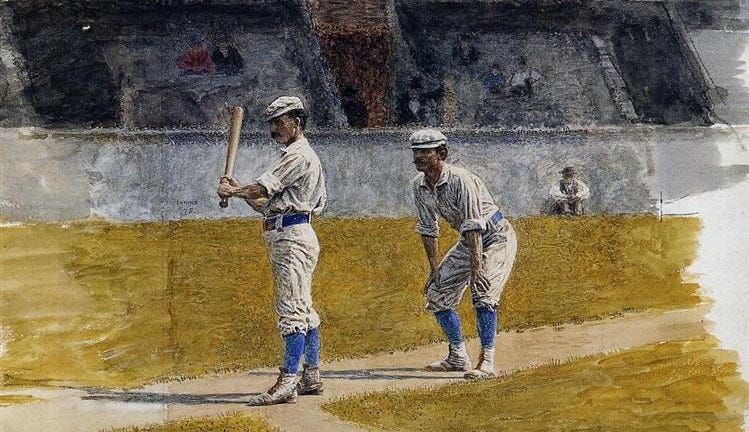
One of the best parts of coaching Little League baseball is helping kids learn to strike out. Now, it’s not like I root for them to fail. But at some point, a strikeout is inevitable, even for the most skilled players on the team. Striking out is so powerful for the same reason it’s so hard: it is an utterly public failure.
Your teammates, your opponents, your parents or grandparents or aunts or uncles—they are all watching. There is no place to hide on a baseball diamond.
In my years of coaching, I’ve found the primary reason kids fear batting is not because they are worried about getting hit by a pitch, but because they are worried about striking out. My job is simple: first, normalize striking out—even the best players in the world do it, and often!—and then, help kids process and come down from the failure.
A common trajectory for most goes something like this:
Tons of nerves before batting.
A strikeout followed by an ocean of tears.
Another strikeout followed by tears, but fewer.
Rinse and repeat until striking out eventually becomes a minor frustration, no longer something to fear but merely a part of the game.
For each kid, without fail, once their fear of striking out diminishes, they have more fun, take bigger swings, and play better baseball. They are no longer tight and playing not to lose. They are free and playing to win. The same kids who were terrified just a few weeks prior begin to let go. They drop their shoulders, and their knees relax in the batter’s box. Sometimes they even lick their lips. It’s a beautiful thing.
***
Striking out is not only something that happens to kids. Adults strike out too. Your date doesn’t call back. Your team misses its target. Nobody downloads your podcast. Your book flops. You miss the lift. You run slower than you’d hoped. Your business fails. Your relationship fails.
And, just like kids—or perhaps even more—adults become so paralyzed by their fear of failure that they, too, take at-bats tentatively, if at all.
Fear of failure kills dreams. Fear of failure shrinks lives.
***
It’s never been easy to fail, but I suspect it’s harder than ever, in no small part because every time you open your computer you are subjected to a never-ending torrent of wild success. His podcast just crossed 100,000,000 downloads. Her Substack now has 20,000 subscribers. His bench press is bigger than ever. Her husband is like the Dalai Lama, only with an eight-pack. Her business crushed. He’s on the forty under forty list. And on, and on, and on. Never mind that the vast majority of success porn is fabricated and created by miserable people, but it has the opposite effect of my Little League coaching: it makes failure seem like an abnormal disease to avoid at all costs.
This is bullshit.
For my latest book, I spoke with hundreds of world-class performers: athletes, artists, chefs, entrepreneurs, musicians, writers, surgeons, coaches. Not a single one avoided failure. Not one!! What I was told again and again and again is some version of If I didn’t have the guts to fail, I would never be where I am today.
Failure is inevitable. For the nine-year-old on my baseball team. For Shohei Ohtani. For you. If you want to get the best out of yourself—if you want to have big at-bats and take big swings, in baseball and in life—you need the courage to face the possibility, in some cases, even the probability, of failure. The following steps can help.
1. Accept the Hurt
You care. You gave your all. You failed.
Of course it’s going to hurt.
This doesn’t mean you are broken or weak. It means you are a flesh and blood human. The pain of failure is the cost of stepping into the arena and living a rich and textured life. When you sit on the sidelines or hold yourself back, you gain short-term safety and comfort, but you sacrifice a shot at your dreams. It’s a terrible trade.
Risking failure may break your heart, but it also fills your life with meaning and joy. You’ll never know what you’re capable of until you try, and if you try—and have the guts to truly test your limits—then at some point you are going to fail. This is just how it goes. It’s the math of the universe. But the math of the universe also says that at some point, you’ll probably succeed too.
I was terrified to submit my first book proposal. I feared getting rejected. I feared what it would do for my then shaky confidence as a writer. So I held onto it for months. I kept revising it. I’d change a sentence one way, then back, and then back again until I’d retraced the same circle dozens of times.
I finally got sick of this cycle and said to hell with it: what’s the worst that can happen? I quickly found out. I got rejected by 27 publishers. It sucked. It was painful. It was discouraging. But the 28th publisher, a little-known house called Rodale (which no longer exists), gave me a book deal. Five books later, and I’ve sold more than 600,000 copies, and my books have been translated into more than 20 languages.
None of this would have happened had I not accepted failure.
The moment you accept failure is the moment you stop being paralyzed by it. It’s just like the kids on my baseball team: striking out becomes not that big of a deal when you realize you aren’t going to melt or die.
2. Abide by the 48-Hour Rule
Following a failure, give yourself 48 hours to feel bad, and then get back to the work itself.
The neuroscientist Jaak Panksepp found the neural networks involved in taking on challenges and problem solving (what he called the SEEKING system) compete for resources with the neural networks involved in fear, rage, and grief (what he called the RAGE, FEAR, and GRIEF systems). In other words, it’s a zero-sum game in the brain. It’s nearly impossible to feel terrible when you’re actively working toward progress.
After something I write flops, there is no better medicine than getting started on the next piece. I loathe doing it every time—feeling sorry for myself is much easier than writing—but I must report that it works every time.
All the high-performing people I interviewed for The Way of Excellence told me the same. Following failure, you want to feel your feelings, but not let them linger. It’s back to the practice facility, back to the studio, or back to the boardroom.
You fail.
You accept it.
You process it.
You learn from it.
And then you get back to work.
3. Build a Robust Sense of Identity
You are more than a result. You are not your failures.
The stories you tell yourself about yourself shape your outlook, attitude, and behavior. Rather than telling yourself the story If I fail, that means I am a failure…
Tell yourself…
…I am a person who has the guts to step into the arena and lay it on the line. I am someone who is amassing experience that will shape my character.
(The latter also happens to be the more accurate story.)
Stop identifying with results and start identifying with the courage to fully embrace the process of living. The biggest failure becomes not having tried at all.
4. Adopt an Infinite Game Mindset
Before his tragic death, Kobe Bryant was asked, “Do you love to win or hate to lose?”
“I’m neither,” he responded. “I play to figure things out. I play to learn something.”
When you fixate on winning, losing, or some other external outcome, it takes you out of the present moment. It makes it impossible to get into a flow state. It makes you fragile. But when you adopt a mindset of curiosity and growth, it relieves pressure and helps you stay anchored.
Kobe Bryant was known for his killer instinct (Mamba Mentality), and yet even he realized the difference between the finite game and the infinite game.

The finite game is time-bound. There are winners and losers. You succeed or fail. The infinite game knows no end. The only goal is to keep playing, learning, and growing.
Anyone who has ever attained their potential knows that you’ve got to play the infinite game. When you embrace an infinite game mindset, failure becomes less scary because it is not an ultimate end. Failure still sucks and hurts (see above), but it’s also something you can learn from as you keep playing.
Of course you want to win as many finite games as you can. But damn if it isn’t helpful to regularly zoom out and remind yourself that the most important game is the infinite one—and that by staying in the infinite game, you increase the odds that you’ll win at least a few finite ones along the way.
5. Become a Humble Badass
Showing up, putting yourself out there, and stepping into the arena is not for the faint of heart. It hardens and softens you at the same time. With each challenge you undertake, you become tougher and more confident. But you also become kinder. You gain respect and compassion for others in the arena because you know how hard making yourself vulnerable to failure can be.
***
It’s easy to sit on the sidelines. To think about the thing. Research the thing. Listen to podcasts about the thing. Talk about the thing. Dream about the thing. But these are all ways of protecting yourself from actually doing the thing.
Only doing the thing is doing the thing.
Another trap is doing the thing but not really doing the thing.
It’s the person who has the website and clothes and haircut and notebook and pen and typewriter and all the other accessories they think a writer ought to have, but what they don’t have is the guts to put themselves out there and write.
They fear failure and rejection, or that their work won’t be read widely. Spending all this time on the act of being a writer is what someone does when they are scared of being a writer.
Writing is an example I know well, but the pattern is universal. You see it in sports, cooking, music, photography, craftwork, and so on. You even see it in parenting. There is no shortage of elaborate ways to feign caring. Underneath each resides fear of failure.
And herein lies the best part about overcoming your fear of failure: you can begin doing all kinds of things in the world and maybe—hell, if you do something for long enough, even probably—succeed. So step up to the plate, drop your shoulders, and take some big swings. Everyone worth a damn strikes out. It’s how the game goes.
So good. Speaking of adopting an infinite game mindset, one of the things we say on our team all the time is, "There's no wins and losses, just wins and lessons." When we get together, we will regularly create space to celebrate both wins and lessons.
The public part is what makes it stick, and my field has the founding example. In 1845 Horace Wells demonstrated his nitrous oxide anesthetic to a room of Harvard medical students, the patient cried out, and the room called him a humbug. His former partner ran essentially the same demonstration successfully a little under two years later, and surgery changed forever. Wells never got that room back, and he was dead within three years. Your 48-hour rule is the step he never got to take.