

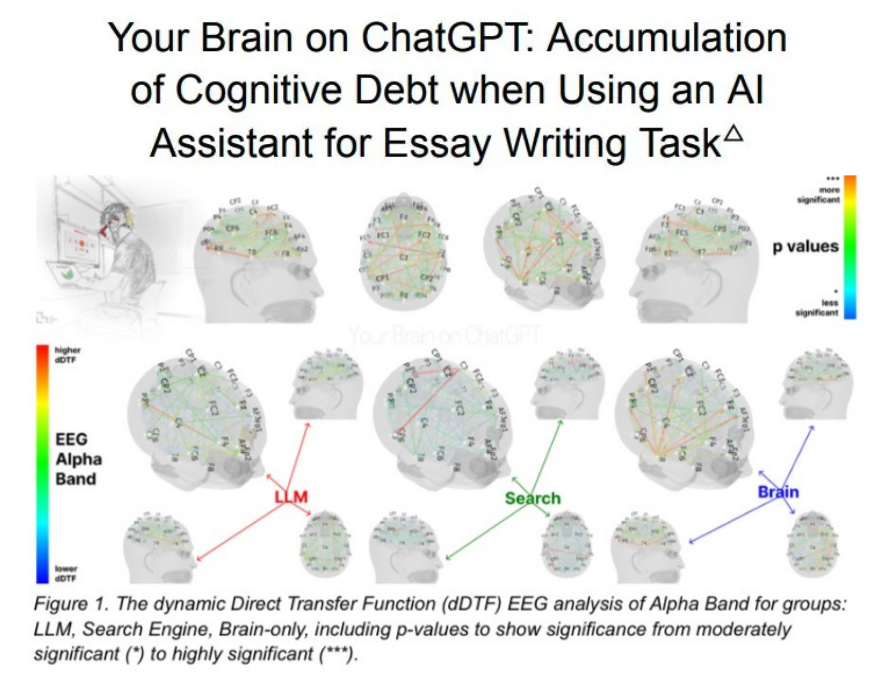
A recent, first-of-a-kind study out of MIT shows that an over-reliance on tools like chatGPT leads to a massive decline in cognitive function. The results are important, and carry practical implications for all of us.
For four months, researchers evaluated what happened to people who used ChatGPT to complete writing assignments for them, versus those who did not. The headline result: “LLM users consistently underperformed at neural, linguistic, and behavioral levels.”
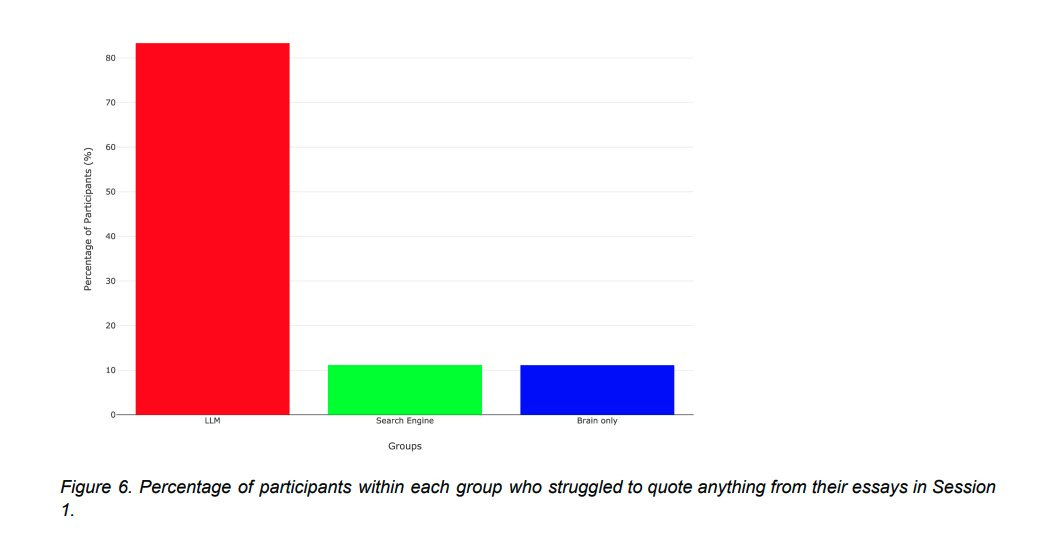
Over 80% of ChatGPT users couldn’t quote anything from work they’d just done. When researchers read the essays written by AI, they used the following words to describe them:
“Soulless.”
“Empty.”
“Standard and typical.”
“Lacking individuality.”
The essays written by AI were scored as flat and homogenized. The writing was punchy, but quickly became boring; all of it had the same synthetic feel. Perhaps most notably, LLM users saw a 47% reduction in brain connectivity compared to people who did not rely on ChatGPT to write for them.
These results may seem shocking, but they also make sense: if you are outsourcing your thinking to a machine, by definition, you don’t need to think, and you certainly don’t need to make creative and associative connections. A hallmark of deep thinking is that it relies on different parts of the brain working together.
When you outsource writing to AI, you negate this process. There’s an old saying in brain research: neurons that fire together wire together. The inverse is also true: the less you use it, the more you lose it.
The Case for Cognitive Fitness
As I was reading this study, I kept thinking that much like your physical health deteriorates if your diet includes too many highly processed foods, your cognitive health deteriorates if your information diet, both what you produce and consume, includes too much highly processed content.
Another useful metaphor for thinking about AI is fitness. If you outsource all your physicality to technology then your physical fitness will decline, and fast. If you outsource all your thinking to technology then your cognitive fitness will decline fast too. When researchers forced heavy ChatGPT users to write without AI, not only did they struggle, but their writing was worse than people who had never used ChatGPT.
Writing in particular provides a heavy cognitive strain. The author and computer scientist Cal Newport interviewed dozens of college students who were heavy AI users. They weren’t using the tools to plagiarize; they were using the tools to write first drafts, provide structure for their work, and help them form ideas. In other words, they were using AI to outsource the hard parts of writing, like “a brain hack used to make the act of writing feel less difficult,” explains Newport.
But a big part of the reason to write is because it is difficult. Writing well is a proxy for thinking well. Using AI to write for you is like going to the gym, but instead of lifting the weights yourself, you bring an apparatus to do the work. You may lift plenty of weight this way, but you yourself aren’t getting stronger. Over time, your muscles will atrophy. Perhaps you become great at configuring and programming the apparatus, but that is a very different skill than a squat or deadlift.
At the same time, it’s pretty great that we have forklifts for moving massive loads at warehouses. A world in which humans have to do all this work without assistance probably would not be better, and there are many ways in which it could be worse. Using AI to sequence DNA and find patterns in massive data sets could help develop therapeutics for diseases like cancer. That is a great use of a forklift; same tool, different tradeoffs. Discernment is everything. The problem is the more we outsource our thinking to these tools, the less discerning we’ll be.
Efficiency, But At a Steep Cost
Relying on AI is efficient. The study participants who “wrote” with AI were much faster, because of course. But what they gained in efficiency they lost tenfold in quality, humanity, and long-term cognitive fitness.
The MIT researchers coined the term “cognitive debt” to explain this tradeoff: what you gain in efficiency now, you pay for later.
These findings are particularly worrisome for young people.
We know the human brain is most plastic until the age of 25. If youth become reliant on AI, they may never learn to think for themselves. Allowing AI in schools without any guardrails would be running a massive experiment on an entire generation in real-time.
Another new study out of Georgetown shows that when people use AI to write, their thinking and ideation homogenizes toward a soulless mean. The sentence structure becomes predictable, even robotic.
Occasionally I eat highly processed foods. I’m still healthy and fit, but I’d never make them the centerpiece of my diet. I still drive a car, and I am grateful for vehicular transportation. But I also make sure to get my steps in. Though I could outsource nearly all my physicality to technologies, I don’t. Because I know that whatever ease and convenience I’d feel in the short-term, I’d be trading for problems down the road. The same is true for the production and consumption of highly processed content.
Protect What Makes You Human
Just last week, a team of researchers from Harvard and the Santa Fe institute analyzed large-language models through the lens of evolutionary biology and complex systems. They published their conclusion in a paper titled: “Large Language Models as a Cognitive Virus.”
The adoption of artificial intelligence, the researchers write, functions exactly like a virus. When you are first exposed to it, you use it a little. But then, as you begin to use it for more and more tasks, it replicates and grows roots in your brain. Perhaps without even realizing it, you start to speak, write, and even think as if you were an LLM. The more you use AI, the more you write, talk, and think like AI, and the more you spread it to other humans. You think you are using the AI, but in actuality the AI is using you—it’s colonizing your being and turning you into a vector for its own proliferation.
The Harvard and Santa Fe paper may seem extreme, but underneath it lies a crucial truth: for all that we think about how to use AI, we also need to think about how to protect ourselves from AI—and not just at the existential level of humanity, but as individual humans. I think more and more people are starting to realize this. One of the most highlighted passages in my new book, the one that people are always sharing on social media, is the following:
The reason I write is because AI can’t make me feel what it’s like when a sentence finally clicks, when the words line up and land just right. The reason I deadlift is because no robot or algorithm can feel a heavy-ass bar start to move off the ground. There are tools that can write more words. There are tools that can lift more weight. More efficiently. More easily. But that’s not the point. The point is the experience, the feeling of being alive. When you increasingly automate this kind of experience in all corners of your life, your life becomes increasingly void of texture. It becomes shallow and empty. Find what makes you feel alive. Protect it.
Where To Go From Here?
We’ve got to be thoughtful about how we use this technology, set constraints and rules for ourselves, and also stop mythologizing AI as an all-encompassing super-power. (It is not.)
The AI companies want you to think adoption of AI for everything is inevitable. The reason for why is simple—their business model depends on it. But I’m not ready to give up what makes me human to enrich a handful of technology billionaires. I think doing so would be a tragedy. The more people tell you that something is inevitable, the less inevitable something is, otherwise they wouldn’t need to keep saying it.
The last digital technological breakthrough was the smartphone. It’s many benefits are undeniable. But, so, too, are some of its costs: for example, those who use regularly use map apps see declines in their innate navigation ability. The rise of the phone-based childhood is strongly associated with a youth mental health crisis, and a large regret of the parents of Gen Z youth is that they gave their kids smartphones too early. (And kids themselves regret their own addictive smartphone use, too.)
The point is that we shouldn’t always just go with the flow in the face of new technologies. At the very least, we owe it to ourselves (and to our children) to identify potential harms and do what we can to reduce them. Losing the ability to navigate without a map is one thing, but losing the ability to think for ourselves is another entirely.
AI is still in its infancy. Its impact on our future—both individually and collectively—depends on our ability to use it thoughtfully. The problem is the more we use it to replace thinking, the less thoughtful we become. Your thinking will deteriorate if you rely on shortcuts. The muscles you have built will atrophy if you outsource them to servers.
None of this is meant to be alarmist. I don’t think being an anti-AI purist makes sense (for a whole bunch of reasons). But it does seem increasingly important to be deliberate and intentional about when, how, and why you use AI—and what you get in return versus what you give up.
Personally, I don’t think AI should be used to produce or consume creative work. Checking for typos and grammar, sure. But actually writing—absolutely not. And I don’t care to read anything written by AI either. Not on substack. Not in a book. Not on social media. It has no soul. It’s synthetic. It’s lame. I don’t find it interesting.
Thinking for ourselves is a central feature of our humanity. So are the feelings that inform our thinking. It’s best we don’t take either for granted.
Thank you for this essay. I hate hearing other writers say they use AI just "to brainstorm." Then they start to use it to organize and to check and summarize their work. Then to draft passages on complex topics that they say they customize or personalize. It's a creep that undercuts our creativity and critical thinking. I use zero AI for writing or for other tasks, including making graphics (like a flyer for a birthday party). I loathe AI graphics. Andrea Bartz (an author and lead plaintiff in the authors' successful class action suit against Anthropic) is an excellent person to follow here on Substack for reasons and ways to resist AI; I recommend starting with her essay, "Why I'm against the use of generative AI altogether" https://andibartz.substack.com/p/why-im-against-the-use-of-generative .
"But then, as you begin to use it for more and more tasks, it replicates and grows roots in your brain"
This ^. I was a heavy user of it; again, it starts small, and then grows pretty fast. Before I knew it, I was using it for coaching what movies I watch, which books to read, and how my lifts were progressing. It was a trap, and quitting cold turkey for over a month now has made me feel more alive and thinking for myself again. Scary, IMO.