

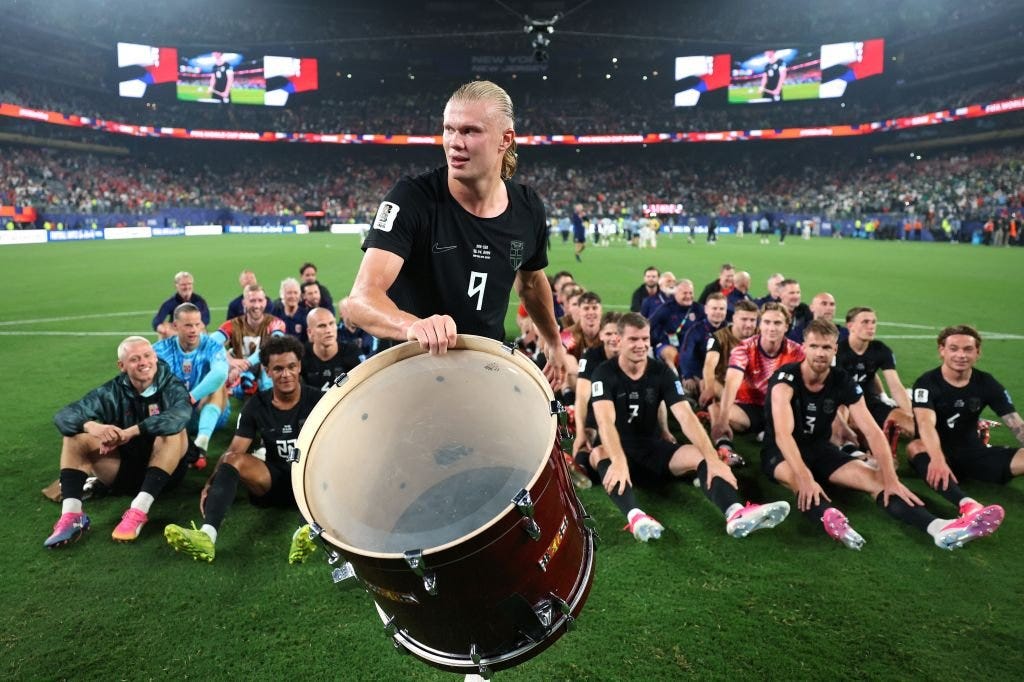
Norway is making a splash at the World Cup, with commanding victories over Iraq and Senegal. Perhaps it’s not surprising given Norway is home to two of the best players in the world: Erling Haaland and Martin Ødegaard. But when you consider that Norway’s population is just 5.6 million people, their success in soccer—and so many other sports—is astonishing.
Norway consistently wins the most medals at the Winter Olympics. In the most recent Games at Milano Cortina, Norway’s per capita medal rate was seventy-five times that of America’s. When I wrote about the medal gap earlier in the year, people were quick to say “it’s because Norway is a winter wonderland” or “they invest in sports nobody cares about.”
But this simply isn’t the case.
If either of those arguments were true, we’d expect Norway to be terrible at massively popular summer sports such as triathlon, cycling, and yes, the most popular sport of all, soccer. And yet, against all odds, Norway boasts world-beaters in all.
Now of course the country loves snow sports. And yes, it matters that Norway is a wealthy country and that the highest levels of Norwegian government invest in their Olympic pipeline. But it seems undeniable that a big part of Norway’s success is how they treat youth sports—and it’s the opposite of what we do in the United States.
Here’s what we can learn from Norway:
1. Scorekeeping
In the US: Youth sports tend to be hyper competitive even at early ages. Leagues almost always keep score.
In Norway: Scorekeeping isn’t even allowed until between the ages of 11 and 13.
Removing winners and losers keeps the focus on the process not outcomes. It keeps kids engaged longer because it minimizes pressure (and tears) and maximizes fun, learning, and growth. The goal isn’t to win a third grade championship. It’s to love sport and keep playing.
2. Trophies
In the US: If you give everyone a trophy, you’re feeding into a culture of snowflakes who will never gain a competitive edge.
In Norway: Whenever trophies are awarded, they are handed out to everyone.
If getting a trophy makes young kids feel good, we should give them trophies. Maybe they’ll come back and play again next year!! As for developing the next generation of snowflakes with no competitive edge—Norway’s athletes are tough as nails, and they keep winning. Give out trophies or not, but the argument that somehow giving everyone a trophy at young ages makes them weak as adults is utter nonsense.
3. Prioritizing Fun
In the US: Far too often, the goal is to win.
In Norway: The national philosophy is “joy of sport.”
Youth sports in the US are driven by adults, ego, and money. Youth sports in Norway are driven by fun. Only half of kids in the US participate in sports. The number one reason they drop out: because they aren’t having fun anymore. In Norway, 93% of kids participate in youth sports. Fun is the foremost goal.
4. Playing Multiple Sports
In the US: There’s pressure to specialize early and play your best sport year round.
In Norway: Try as many sports as you can before specializing as late as college.
Norway encourages kids to try all types of sport. This reduces injury and burnout and increases all-around athleticism. It also helps promotes match quality, or finding the sport you are best suited for as your body develops, which is impossible if you commit to a single sport too early.
5. Affordability
In US: There is increasingly a pay-to-play model with high fees for leagues, equipment, and travel. This excludes many kids from playing.
In Norway: It’s a national priority to keep youth sports affordable and therefore accessible for all.
Kids aren’t priced out, which creates opportunities for everyone to participate (and develop into athletes), regardless of their parents’ income level.
Norway’s sporting success isn’t just speculation or a nice story. A large body of research supports their approach:
Studies show athletes who specialize later in life have a significantly higher chance of becoming elite.
Soccer players whose motivation is primarily internal (versus external) have more than a 3x better chance of making it to an elite level.
The number one predictor of whether or not kids stay in sport is are they having fun.
Parents connect winning to having fun whereas kids say having fun is about being with their friends and learning.
We Could Learn a lot From Norway
I’m not writing this from an Ivory tower or with a removed Utopian view. I’ve got two young kids, and I coach them both. I understand the American system. I understand the urge to win because I feel it myself. I understand the feeling of not wanting your kid to fall behind. I am often the first coach to tell the eight-year-olds they need to do a better job focusing. I also understand how much fun it can be to go to a weekend tournament with a great group of kids and families. I’d much rather my kids be on a slightly too-competitive baseball team than in the basement on screens all day. I’d love for my kids to make high-school teams (if that’s what they desire), and I want to give them every opportunity to do so.
And yet, it’s undeniable that in the US, youth sports in the US has become a mess, with angry parents, outsized egos, and astronomical costs keeping kids from sticking with it long enough to see what they could become. Seventy percent of kids drop out of by age 13. This not only diminishes the pipeline of elite athletes, but it also creates a hindrance for healthy habits and all the character lessons kids can learn from sport.
In Norway, lifelong participation in sport is the norm. In order to compete on an international level with a country so small, you need to keep the talent pool as wide as possible for as long as possible. The goal isn’t to have the best 9-U team. It’s to develop the best athletes. Those are two very different things, and Norway has the medals to prove it.
The United Sates may never have the exact same model as Norway, but we can certainly move closer to it and adopt its spirit—keeping the emphasis on joy, intrinsic motivation, and developing a wide range of skills. Not only would we have more fun, build more character, and be healthier; but we’d win more too.
Norway's edge isn't that they find more talent. It's that they lose less of it. Early specialisation selects for whoever is best at age 10, which is mostly whoever is biggest at age 10. That filters out every kid who would have been elite at 18 but hadn't finished growing yet. The Norwegian system keeps the pool open long enough for talent to separate from physical maturity, and by the time the selection happens the late developers have arrived.
5.6 million people producing more elite athletes than 330 million isn't a miracle. It's maths. America narrows the funnel at age 8 and wonders why the adults who come out the other end aren't as good. Norway keeps the funnel wide until 13 and lets biology finish the conversation that coaches started too early everywhere else. The talent was always there. The system just stopped throwing it away before it could show up.
This made me smile: “I am often the first coach to tell the eight-year-olds they need to do a better job focusing.”