

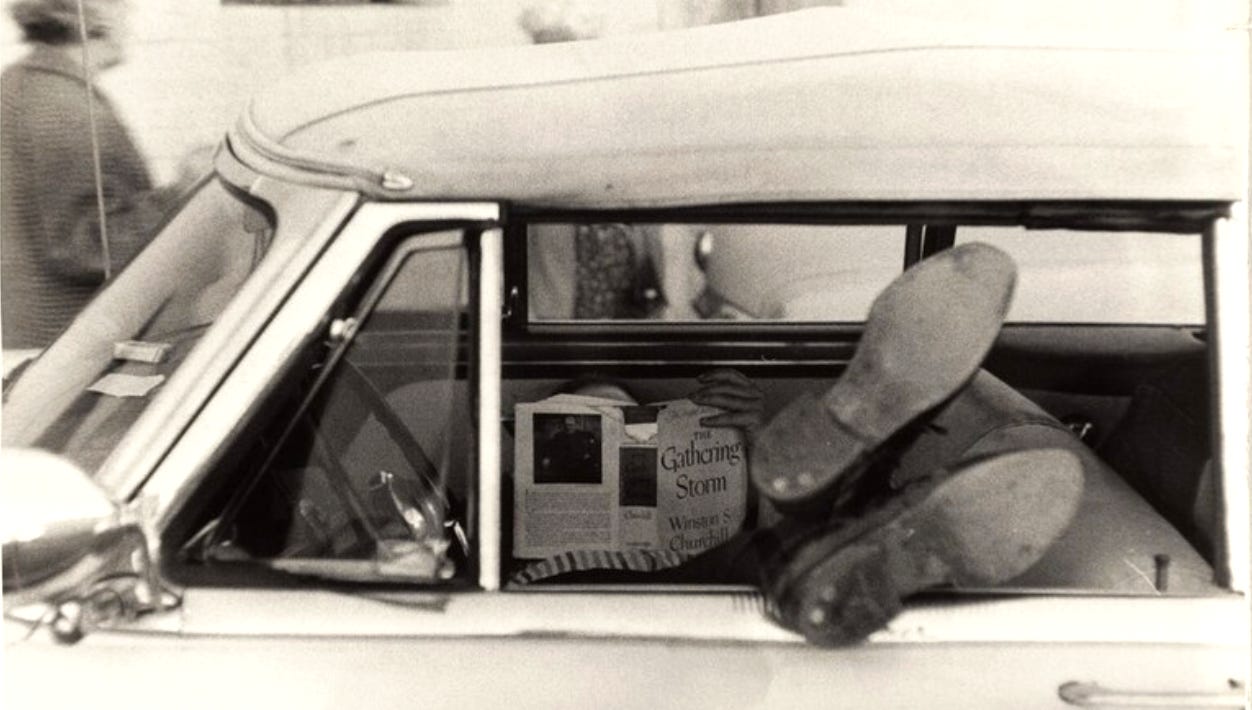
On a recent flight from Charlotte, NC, to Traverse City, MI, I counted three people reading. I was one of the three. To be fair, a handful were watching sports and movies. But more than anything, I saw people buried in their phones.
Around the same time as my flight, an Atlantic cover story, “The Age of Reading is Over,” went viral for highlighting some terrifying trends.
51% of adults read 0 books a year. Only 16% read daily.
Reading has declined by 43% over the last 20 years. The decline cuts across age, gender, and race. 54% of adults now have literacy levels below those of a sixth grader.
You can observe the decline not just on planes and trains, but at pools and in doctors’ office waiting rooms. You used to see people reading books and magazines. Now, just about everyone is swiping down on short-form video. Here are findings from three recent studies on that medium:
A study from earlier this year uncovered that people who regularly watched short-form video (e.g., TikTok and Reels) underwent changes in the neural networks responsible for attention and impulse control. In particular, the braking mechanism of the brain, which would otherwise help someone decide to stop watching and put the phone away, deteriorated.
Another study, aptly titled “The Cognitive Costs of Brain Rot,” found that the fractured attention, cognitive overload, and mental exhaustion that are part and parcel of heavy social media use contribute to burnout, depression, and anxiety.
A 2025 meta-analysis—a review of 27 studies that included 98,000 people—found that consuming short-form video leads to a significant decline in cognitive function, attention, and self-control. “Repeated exposure to highly stimulating, fast-paced content may lead to habituation, wherein users become desensitized to slower, more cognitively demanding tasks such as reading, problem solving, or deep learning,” conclude the authors.
The research shows what so many of us have experienced firsthand. When you get sucked into scrolling, it’s hard to stop, you feel like crap, and your ability to maintain attention and any sort of depth diminishes, if not flames out altogether. It’s bad for the individual mind, and for the collective one. No wonder it seems like all the serious people have gradually disappeared.
The synthetic slop revolution is doing to our brains what the industrial revolution did to our bodies. Consuming too many highly processed foods led to metabolic dysfunction and a diminished desire for more nutritious, whole foods that actually make you feel good. Consuming too much highly processed content is leading to neurological and emotional dysfunction and a diminished desire for deeper and more fulfilling material, such as books.
Life is too short to surrender your brain to an endless deluge of stupid, soulless, mind-numbing crap. It’s addictive in all the worst ways. We are at a point in history—not nearing it, but here—where each and every one of us is going to have to decide if they are content to numb themselves with an endless stream of fentanyl-like digital slop or if they are going to fight for their humanity and touch grass and challenge themselves and create and contribute and love.
Short-form video, and social media more broadly, are not going away. But you need to be thoughtful about how you consume it and set constraints for yourself. Occasionally, I eat highly processed foods. I’m still healthy and fit, but I’d never make highly processed foods the centerpiece of my diet. The same is true for highly processed content.
The best thing you can do to reclaim your ability to think deeply is also one of the simplest: read a book. Reading a book is like consuming healthy foods and going to the gym all at once, but for your brain.
When you read a book, you consume unprocessed information in context. You can think of context like fiber: it slows digestion and is the first thing stripped away in highly processed short-form video crap. At the same time, you exert and strengthen focus. You may be uncomfortable at first, especially if you’re out of practice, but reading is a muscle you can rebuild. Eventually, it becomes enjoyable—you reach a point where you’d rather read a book than scroll because of how you feel after, because of how it nourishes your brain (and soul) instead of burning it out.
Reading a book asks something of you that almost nothing else in modern life does: it asks you to stay with one idea, in one place, for an extended period of time. It asks you to wrestle with complexity, pay attention to someone else’s thinking, and ultimately think for yourself. When you have a deep reading practice, you regularly get to experience the joy of losing yourself in a story and the exhilaration of making a new connection or thinking an original thought.
Though the state of reading may seem grim, there is some light in the dark.
The decline isn't evenly distributed, rather, it's a story of concentration. A YouGov survey from the end of 2025 found that 19% of Americans accounted for 82% of all books read that year, and the top 4%—those reading 50 or more books—consumed 46% of the total.
You could interpret this data in two ways: the first is that reading is becoming an elite activity for a very small subset of the population. The second is that there is a strong, passionate base of readers holding the line—and what’s needed is an indiscriminate recruiting policy to expand the number.
Book snobs may take issue, but let’s be real, at this point it doesn’t matter if it’s fiction or nonfiction, a classic or a recent release. We just need to get people back to reading, period.
Start with a book you'd actually want to read. Set aside even just 20 minutes a day. Place your phone in another room. Prioritize consistency. It’s good to think of yourself as a reader, but merely holding a book as a status symbol doesn’t do any good. You actually have to read. Reading can—you could even argue reading must—be at the heart of any humanist resistance to technologically driven brain rot.
Whether you’re a voracious reader who is out of practice or someone who hasn’t read many books before, now is the time to get as serious about reading books and your cognitive health as you are about your body and your physical health.
Refuse to doomscroll. Read a book. Reject AI slop. Read a book. F*ck the machine. Read a book. Save your brain. Be the counterculture. Read a book.
To your point in the intro, just because someone is on their phone doesn’t mean they’re not reading, especially on a plane. I prefer to read on the Kindle app on my phone on a plane so I can use the motion sickness setting, or I’ll listen to an audiobook. I can’t read a physical book on a plane or in a car. I read over 100 books a year for the past 6 years I’ve been tracking on Goodreads by the way.
Almost every day I'm amazed how much people get lost in the 5.3" screen. If only people time traveled from the 1980's, they'd think we'd gone mad. Let's fix it, one book at a time.