

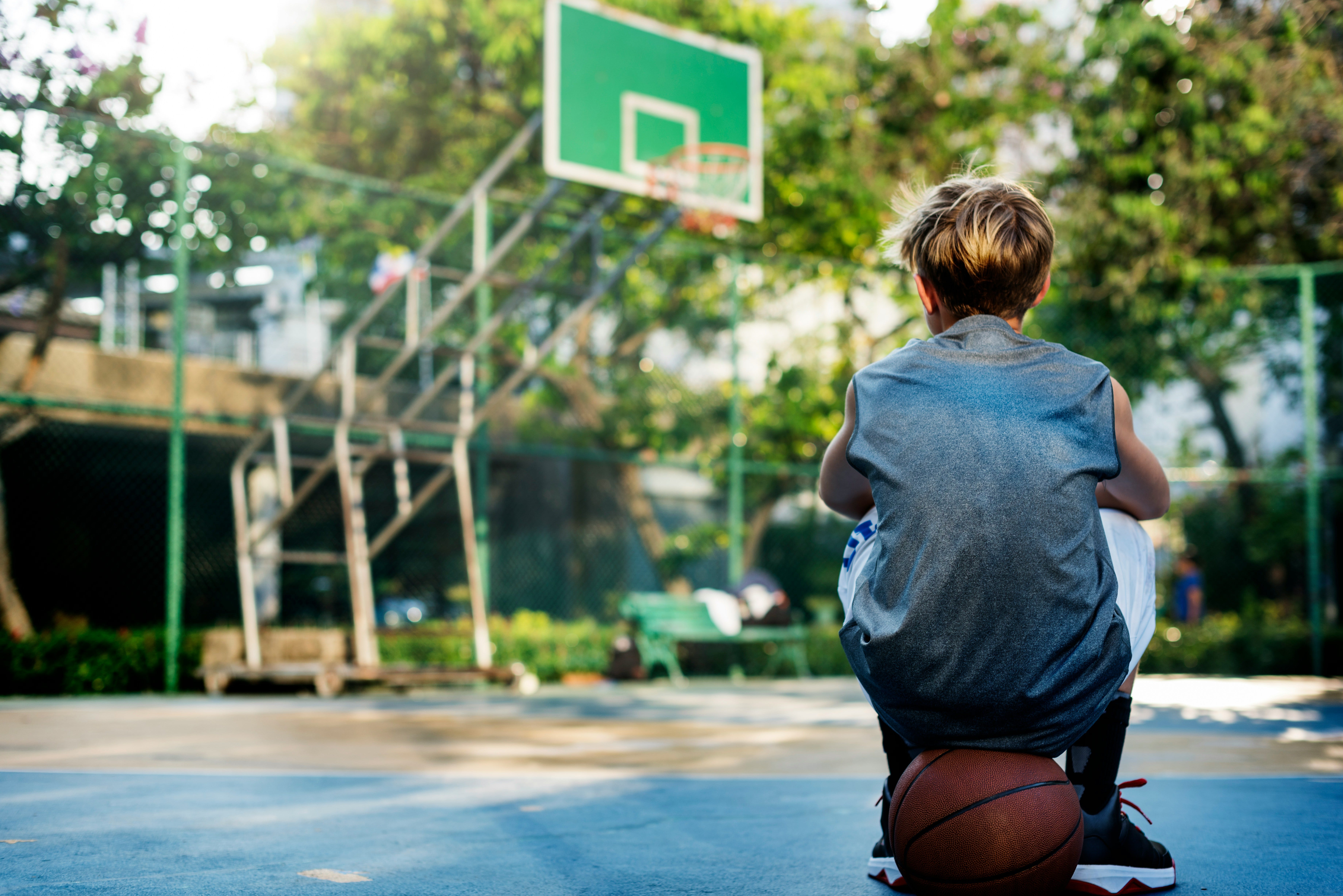
I have an eight-year-old son and a three-year-old daughter. My kids will be the first to tell you I’m no parenting expert. When I look at the world, I see a chaotic, uncertain place changing faster than ever. It’s hard to predict what skills will be relevant next year, let alone a decade from now. And yet there are two in which I have a high degree of confidence: how to shoot a basketball and how to read a book. Taken together, they comprise a large part of my parenting philosophy. Let me explain.
1. How to Shoot a Basketball
Slight bend at the knees. Feet and shoulders square to the basket. Elbow in tight. Lift through the hips and trunk. Extend the arm as the body rises. Finish with a flick of the wrist. Hold the follow-through. Some coaches may have minor objections, but this is more or less how you shoot a basketball. It is simple but not easy. You improve via repetition. The results are objective and concrete—the ball either goes in the hoop or it does not. It’s hard. It’s fun. There is a direct line between effort and result.
My son loves basketball, at least for now. It’s still a bit too early to tell for my daughter. Maybe she will, maybe not. And that’s okay, because there’s nothing particularly special about shooting a basketball. It could just as well be playing the violin. Or striking a soccer ball. Or painting. Or acting in the theater. Or learning how to dance.
What I’m getting at is the development of a real skill in the real world. Something that is challenging and at times uncomfortable. Something that forces you to push against limits; to overcome resistance, setbacks, failures, and keep going. Something with stakes. Something in which to build competence.
It’s never been easier to coast. You can sit around on screens all day and be a passive recipient of a homogenized, soulless algorithm. You can use AI to answer questions, write papers, and even date. You never really have to put yourself out there. You never have to risk failure. These are deeply concerning trends. Learning how to shoot a basketball confronts them head-on.
You can’t automate or fake shooting a basketball. As such, when you learn how to do it, you develop what psychologists call self-efficacy: an evidence-based belief that you are capable of showing up, navigating challenges, and excelling as a result of your own hard work. Decades of research show that individuals who score high in self-efficacy tend to have better outcomes across various measures of life satisfaction.
I don’t expect my kids to be wizards at everything. I want them to try a range of activities and find what they enjoy. But I do think it’s important that at least one of those activities is learning how to shoot a basketball—be it actually or metaphorically.
2. How to Read a Book
Recent research from University of California, Irvine professor Gloria Mark suggests the average adult attention span is currently 47 seconds. That’s pathetic.
Almost everything worthwhile—appreciating art, creating something novel, falling in love—requires sustained attention. The quality of your attention shapes the quality of your life.
I believe reading books is one of the best ways, if not the best way, to build your attentional muscle. Reading teaches you to experience distracting thoughts and feelings and to return to the text in front of you, again and again. Eventually, the distractions subside. Perhaps you even lose yourself in the narrative. This sort of deep focus is a wonderful feeling, a reward in and of itself. Experience that rewards enough, and eventually you start to choose focus over distraction in other areas of life too.
Yet learning how to focus is only a small part of what makes reading profoundly valuable. It exposes you to ideas across geographies and eras. Reading is far more active than listening or viewing. It is also slower and more imaginative. You have to create the mental imagery and tone of voice. You have to dictate the pace at which you consume the text, think about what you are consuming, make connections in your mind, and then continue on.
Reading develops agency—which is precisely why every totalitarian regime throughout history is eager to ban books. Learning how to read is learning how to create the conditions to think for yourself: slow, deliberate, contextual, and without interruption. It’s in direct opposition to the synthetic slop-stream that encompasses so much of modern life.
None of this means my kids don’t ever watch television or play NBA 2K. (They do, within reason, at least most of the time, but sometimes it rains for hours in the summer.) It simply means that we rarely go a day without reading, and that working toward competency in an age-appropriate way—it has to be fun!—is an ever-present force in our lives. When you combine the two, you increase the odds that your kids will be fulfilled and successful in life.
Another important quality I want my kids to develop is kindness. Sadly, this too seems to be falling out of favor. Cruelty increasingly gets rewarded with attention, especially online. As Derek Thompson recently wrote, we’re in an era of vicemaxxing, where treating people well is framed as naive, as something that makes you a pushover.
But disregarding kindness is a path to nihilism; in the body politic and in the individual body, too.
The least kind people I know are also the most empty. Small kindnesses—saying thank you, holding open doors, paying attention to other people—enrich your life and fill your heart. Much like shooting a basketball or reading a book, kindness is a skill. You get better through practice and repetition. My job, as best I can tell, is to ensure my kids get enough reps—at home, with each other, out in public—so that kindness becomes a habit before society tries to wring it out of them.
Perhaps my parenting philosophy is countercultural, which is fine by me. The prevailing culture rewards the opposite of all three: passivity, distraction, and contempt. I’d rather my kids be out of step with that.
Get competent at something. Learn how to read. Be kind.
I spent most of my childhood years reading crazy amounts of books and playing basketball or soccer every day. The convictions "I can get good at stuff" and "I can think for myself" are really powerful if internalized early on.
You’re in Michigan. Basketball?
I thought you’d have gone for: Learn how to skate, to give a fair body check, and to take a body check.