

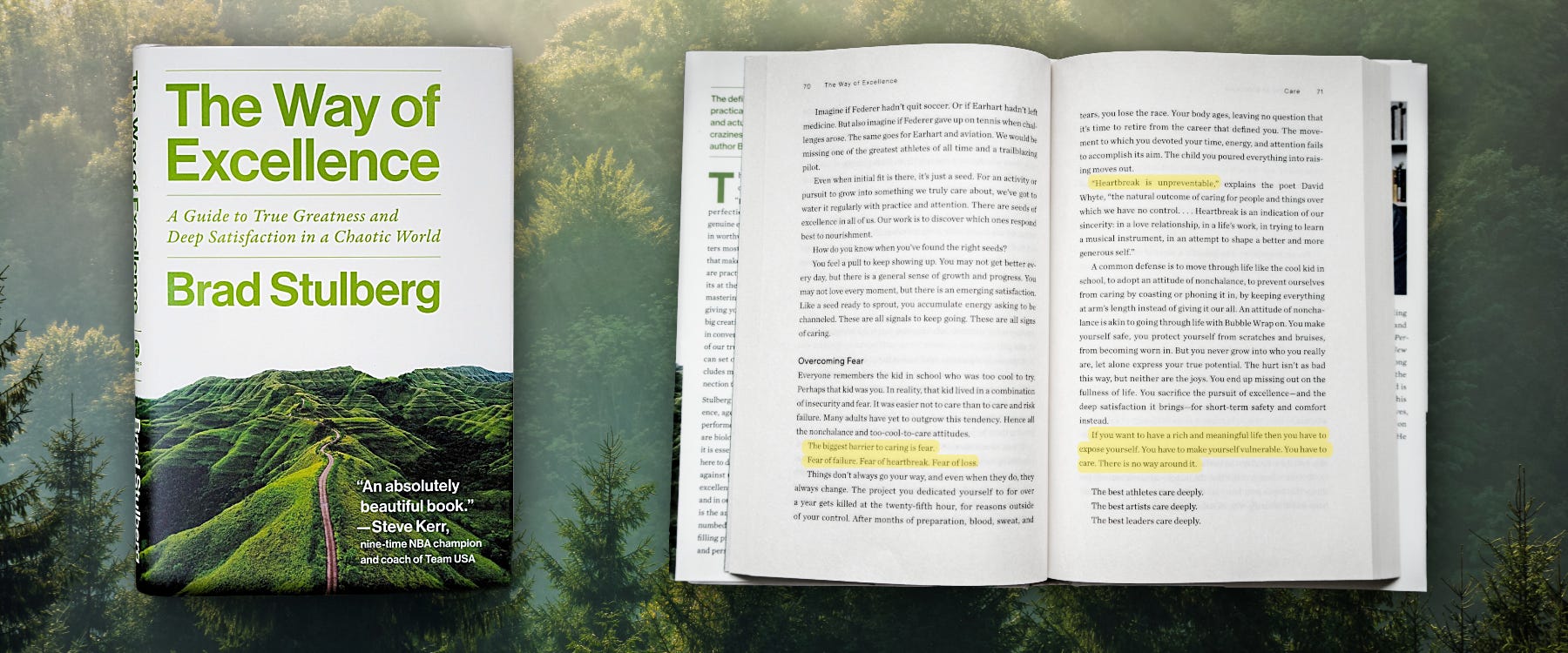
The Way of Excellence has been out in the world for a little over a month. In that time, I’ve received more than 1,000 messages and social media tags from readers—and clear patterns have emerged. The same ideas keep coming up, over and over, from people in wildly different walks of life.
Here are the eight themes resonating most—and what I think they tell us about what people are hungry for right now.
1. Caring is cool.
You are not going to be the best anything, including the best version of yourself, with an attitude of nonchalance. Step in the arena. Try hard. Give a damn.
There’s an all too common brand of malaise, nonchalance, and apathy people wear as armor to avoid fully stepping into the arena. It’s easier to sit on the sidelines, scoff, complain, make commentary, and point out the ways in which people are doing everything wrong than it is to actually try yourself.
Carl Jung wrote that “the world is full of people suffering from the effects of their own un-lived life. They become bitter, critical, or rigid, not because the world is cruel to them, but because they have betrayed their own inner possibilities.”
There is no replacement for trying—for shedding the self-inflicted weight of being too cool. Trying hard, caring deeply, and giving your all to worthwhile projects is anything but cringe. It is cool to care and the world needs more of it. I’m glad people are waking up to this.
2. The ability to have fun while working hard is one of the greatest competitive advantages there is. Joy and struggle can coexist, and in the best performers, they almost always do.
Somewhere along the way we decided you’re either the person who suffers for greatness or the person who has fun. That’s a false choice. The best performers I’ve ever studied carry both. They are focused, determined, a little bit crazy, at times obsessive, and live mundane lifestyles that most people would find boring. That is all true. But the best performers in the world also experience deep joy in their crafts. What makes for greatness is being intense and joyful. It’s the joy that makes the ferocious dedication, drive, and intensity sustainable.
The real danger isn’t struggling too much or having too much fun. It’s feeling nothing at all. It’s floating through life on an algorithmic conveyor belt to nowhere. The antidote is putting yourself out there. Picking up something hard; falling down and getting back up. A good life is not the absence of struggle. It’s finding something worth struggling for and doing it with a smile on your face more often than a frown.
3. There is no greater illusion than thinking the accomplishment of some goal will change your life. What will change your life is who you become in the process of going for it.
When people are interviewed at the end of their lives, they almost never reflect on awards won, promotions earned, or podiums topped. Rather, they predictably say what mattered most were the people with whom they spent time and the experiences they had while undertaken big projects—from winning an NBA championship to raising kids to publishing a book to completing medical residency.
The top of the mountain is narrow. All the life is on the sides. The satisfaction, fulfillment, and love you are looking for is not going to come at the point of achievement. It is going to come in the process you take to get there. There is nothing wrong with wanting to reach the top of the mountain. (I sure as hell know I do.) But if you aren’t digging where your feet are and occasionally enjoying the view then you will not last very long.
4. The secret is there is no secret: consistency over intensity; fundamentals over fads; progress over perfection; over and over again.
Humans are wired to crave shortcuts, hidden truths, and hacks. There is an entire industrial complex built to prey on this wiring: supplements, diets, technologies, optimizers, influencers, and all manner of trends and bright and shiny objects.
The unsexy reality is that 99 percent of it is bullshit. If you want to learn or grow or achieve or find the rare satisfaction that is a byproduct of gaining competence, then you’ve got to do the work. There is no way around it.
Everyone longs for the transcendent moments, but they only occur if you’ve committed to the boring and tedious and sometimes downright mundane fundamentals first. Sometimes for months. Sometimes for years. Sometimes for decades. You’ve got to learn to find the basics interesting and be endlessly curious about your craft (and about yourself).
5. You don’t always need to feel good to get going; sometimes you need to get going to give yourself a chance at feeling good.
Motivation and inspiration are just like any other emotions: they come and they go, and often on their accord. Don’t let yourself become a slave to them. Rather, become known for your consistency.
On the evening of June 14, 2025, the golfer JJ Spaun’s three-year-old daughter became violently nauseous. Spaun was up all night, including a trip to the only open drug store in town to pick up medicine. If he was wearing a recovery tracker, his score would have been 0. He described the night as “chaos.” The next morning, he played a near perfect round of golf and won the US Open.
Show up. Get Started. Give yourself a chance. You can always shut things down if need be.
6. Build an Identity House with More than One Room
Caring deeply about something means beginning to identify with it. You start saying, I am an artist or I am a chef or I am an athlete or I am a musician or I am a doctor or I am a writer. It goes from being something you do to being part of who you are. This is to be expected. It is a sign of full engagement and intensifying care, a wonderful feeling. But it isn’t without risk.
That’s because when an activity becomes the entirety of who you are and something goes wrong, it upends your sense of self. Just knowing this could happen creates a source of unnecessary tension.
I’ve come to think about identity like a house: If you live in a house that only has one room, and it floods, then you have to move out of the house. It is a disorienting experience. But if you live in a house with multiple rooms, and one room floods, you can seek refuge in the other rooms while you repair the damage. The goal is to build an identity house with at least a few rooms, because you never know when one is going to flood and you’ll need to find strength and stability in the others.
You don’t need to spend equal time and energy in each room. (You won’t.) You just need to have more than one.
7. It’s shocking the number of bizarre things people do to “optimize” their health, longevity, and performance; and yet they don't exercise regularly, sleep 7 hours, eat fruits and veggies, build community, or ever relax.
A common trap high performers fall into is over-optimizing everything and cutting corners around the necessities. They obsess over the 0.1% but not the 99.9%. No supplement will cover up a bad diet; no stimulant will reduce the long term effects of overwork; no number of social media followers will be as fulfilling as meaningful struggle and relationships.
It’s normal to plateau and seek out solutions in hopes of realizing progress again. But progress will never come at the expense of the basics. Don’t major in the minors. Keep the main things the main things.
8. Excellence is not a destination; it is a process of becoming: The real reward isn’t just a bigger deadlift, a faster mile, or a sturdier table; the real reward is that you become a better version of yourself.
Committing to a craft teaches you about doing hard things, facing discomfort, overcoming setbacks, and the power of community, perseverance, and persistence. These qualities extend to all of life.
The word character comes from the Greek charassein, meaning to engrave or stamp upon. When we throw ourselves into worthwhile projects and pursuits, we engrave or stamp upon ourselves the type of person we are growing into.
No matter where you start or what you’re trying to do, you will benefit from trying, and failing, and trying again anyway. This, at root, is how growth works.
Growth in a craft. And growth as a person too.
If any of these resonated, the full book goes much deeper. I promise you’ll find it valuable. Get The Way of Excellence here.
Thank you for sharing your words. It's not a one time thing that helps me get better and happier. It's the constant awareness of the little steps that add up big.
“Gumption”