

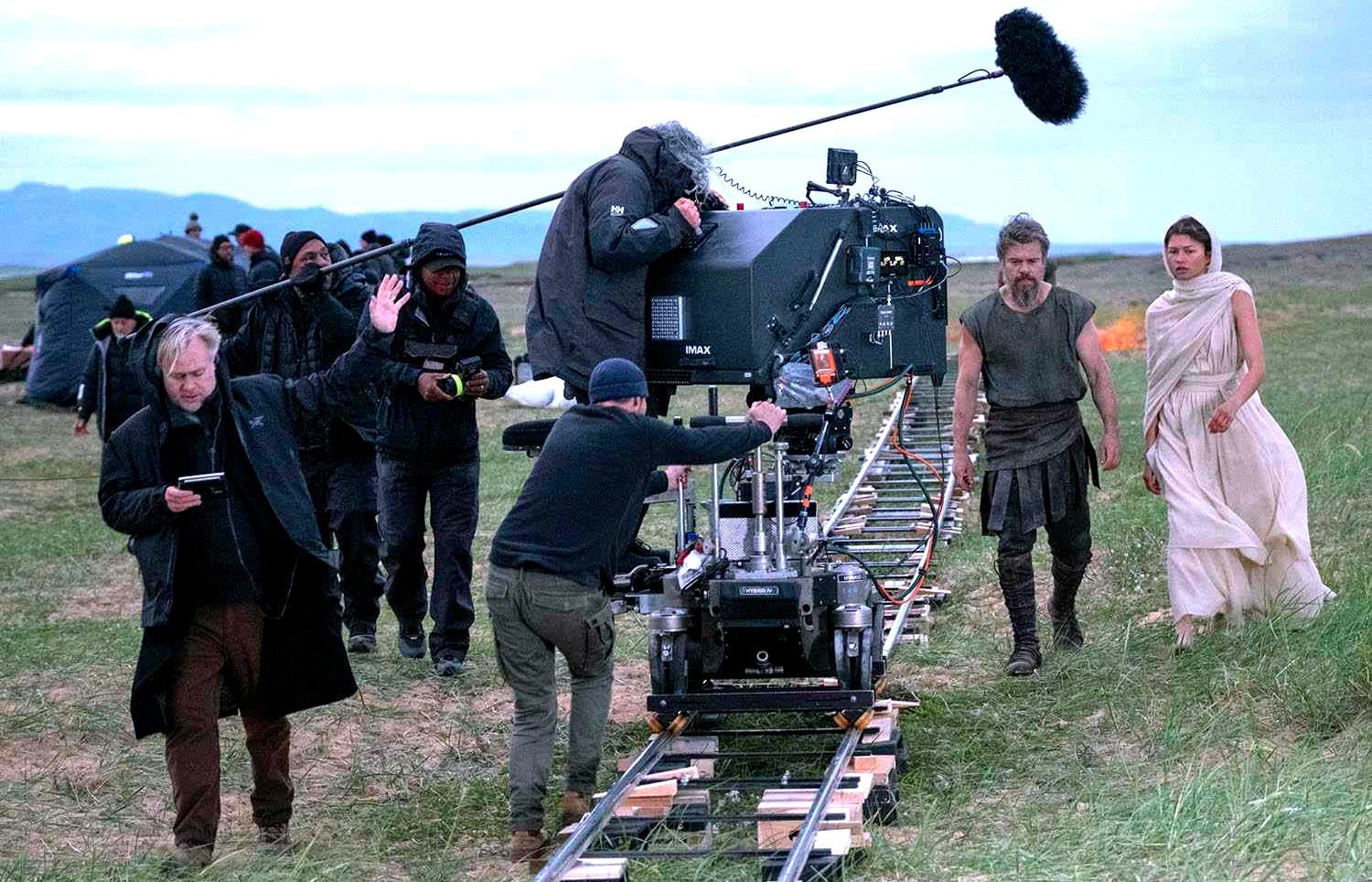
When asked about his creative process, director of The Odyssey, Christopher Nolan said, “I treat every film I do like the last I’ll ever make—and one day I will be right… So every time I want to put everything into the project at hand. I’m never thinking, ‘Well, I’ll save this for the next one.’ I don’t ever want to think like that. I want each movie to be everything.”
Everyone is talking about The Odyssey. I think that’s because in an era of automation, shortcuts, and slop we crave hard-won care and competence.
Nolan has achieved everything a filmmaker could dream. He won an Oscar for Best Director in 2024. His movies have grossed more than 6 billion dollars. And yet, he still returns to each project with a desire to further his craft and make something awesome. Three decades into his career, at age 55, he’s outdone even himself.
The Odyssey was shot differently than any feature film before. It’s the first movie to be filmed entirely with IMAX cameras. The cameras had to be reloaded with film every three minutes. Nolan avoided using green screens, even though it would have made filming easier. Crews faced nasty weather and rugged terrain during the 91-day shoot across Greece, Iceland, Morocco, Italy, and Scotland. All told, the movie required two million feet of footage.
When asked by Jon Stewart how he managed to finish shooting the film 9 days early, Nolan said, “By day 91 we couldn't have taken another step. So we finished (at) the right time. We were done. Everybody was done. I mean people were just exhausted.”
Nolan obsesses over quality and craft. It explains why so many are gravitating toward the film, and why it’s opening to enormous anticipation. Amid the shallows, deep effort and craftsmanship stand out. It feels this way even more than it did five years ago. People are sick of an ephemeral stream of junk content. People are sick of half-assed, highly-automated effort. People are sick of half-assed, highly-automated lives. The Odyssey flies in the face of all this.
The story itself encapsulates what the mythologist Joseph Campbell calls “The Hero’s Journey.” Someone goes out on a quest, faces trials and tribulations, and returns home a better and stronger person. I think, at root, we all crave this too.
It’s not just that the movie he made is emblematic of the hero’s journey, but Nolan’s own career too. He’s on a quest to be the best at his craft that he can possibly be. He doesn’t let an opportunity to learn go to waste. Nolan has said that even his early corporate-video work—throwing up lights to shoot in-house interviews with executives—was teaching him his craft.
Thirty years later, no one was forcing him to do months of relentless prep for The Odyssey. No one forced him to tour remote villages or to make every effect as practical as possible. Nolan did it because he takes responsibility for his craft. He values the art. He values his audience. He values himself.
Therein lies an incredible lesson: when you give something your all you take responsibility for it. You face the very real chance of failure and accept the outcome, whatever it may be. “I can't blame the studio or anything like that—if the film doesn't work, it's my fault. If I fail, I fail on my own terms.” Nolan says of his work.
The Odyssey resonates because both the end result and the process that created it speak to something in all of us: we are starved for depth; we yearn to go on quests; we desire competence; we want to throw ourselves into big, scary, challenges that shape our character; we long to spend our finite time putting our all into things that matter.
The detail that stays with me is the corporate-video work — lighting exec interviews decades before The Odyssey, already treating it as craft. He couldn't control whether it would ever amount to anything. He could only control what he put into the room that day.
That's what people miss when they praise his "results." The six billion, the Oscar — those are outcomes, never fully his to command. A film can be everything he had and still miss. What's his is the 91 days, reloading film every three minutes, refusing to green-screen the easy thing. If it fails, he said, it fails on his own terms. That line only works once you've accepted you don't control the verdict, only the work you feed into it.
I wrote about this — there's one lever that stays within reach even when the world unravels around us: the quality of our effort. Not the outcome. Not the applause. Just how we show up. It's an input like any other, a declaration of how we intend to live. Nolan's whole method is that sentence made physical.
And notice he's no reflexive AI-hater. He's careful to say the tech isn't "useless or meaningless" — just that in filmmaking it's "hitting at exactly the wrong time," right as people rediscover a hunger for the tactile and real. That's the sharper point. The problem was never the tool. Craft becomes legible again precisely when so much around it is made the fast way, by people who took no responsibility for it. When faking effort gets cheap, the real thing glows.
Seeking mastery and mattering. I read that in your work a while back and it’s become a core value - maybe a central organizing principle - for me. So I pour my heart into every piece I build.