


Over the past few weeks, I’ve made a handful of posts drawing out lessons on excellence from sporting events. I wrote about the Wimbledon Tennis tournament and the rivalry between Carlos Alcaraz and Jannik Sinner. I wrote about the golfer Scottie Scheffler’s viral press conference on his struggle to find fulfillment, even though he’s the top ranked player in the world. I wrote about JJ Spaun winning the US Open after waking up at 3 AM to care for his sick child. In each of these stories, I explored resilience, consistency, patience, presence, and focusing on the process—and argued these ideas apply to all of us.
I received many comments across platforms, most of them overwhelmingly positive. But a few folks left notes that capture the biggest misconceptions about what excellence is, who excellence is for, and the difference between hustle-culture excellence and actual excellence. Let’s clarify.
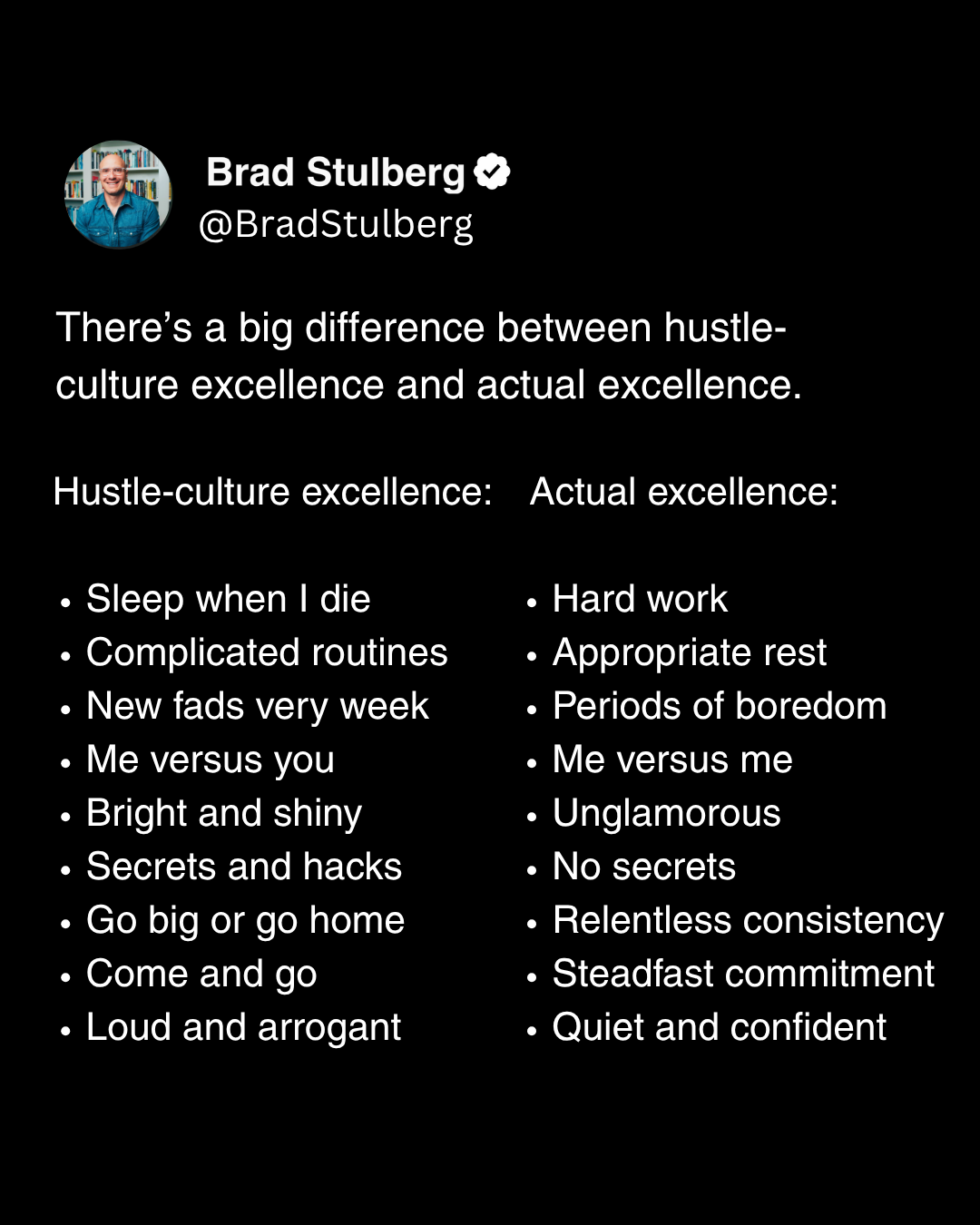
There’s a Difference Between Hustle-Culture Excellence and Actual Excellence
Hustle culture excellence: Sleep when I die; Complicated routine; New Fads very week; Me versus you; Bright and shiny; Secrets and hacks; Go big or go home; Come and go; Loud and arrogant.
Actual excellence: Hard work; Appropriate rest; Periods of boredom. Me versus me; Unglamorous; No secrets; Relentless consistency; Steadfast commitment; Quiet and confident.
The former is a recipe for emptiness and burnout. The latter leads to deep satisfaction and sustainable performance. The two are often confused on the internet, which leads people to pursue excellence entirely the wrong way, or to give up on it altogether. It’s unfortunate, because as you’ll read below, the pursuit of actual excellence is something we need now more than ever.
Excellence is Not About Perfectionism or Winning at all Costs
Actual excellence is about more than just results. This isn’t woo-woo. And it doesn’t mean results don’t matter. (They do!) But they aren’t the only thing, or at least they don’t have to be. The point of pursuing excellence is the exhilaration, self-discovery, and self-respect you gain from giving something your all.
It’s not just about where you end up. It’s also about the person you become and the life you live along the way.
Caring deeply and giving something your best shot—in whatever endeavor you choose: from art to sport to parenting to starting a company to writing to coaching to making music—is a big part of what makes life full and meaningful, regardless of where you fall in the rankings.
It feels good to work toward mastery, to create and contribute in your own unique way. This has always been the case, but it feels especially true in today’s numbed out world, where it’s easy to get caught up in going through the motions. Aspiring toward excellence presents a vital alternative.
What About Genetics?
Someone named Alan made the following comment on one of my posts about Wimbledon:
“Most people in the world lead ordinary lives and make the best of them as best they can without having to, or wanting to, dedicate themselves to the intensity that you describe. It's called having a life. These high-achieving sportspeople have been gifted a talent by their genes that they have decided to avail of and hone to the best of their abilities which is very entertaining for their supporters and that's it. Those of us without such talents will never succeed at tennis no matter how much we dedicate ourselves to it or strive to overcome our lack of ability. This is true of every area in life that requires particular talents.”
It’s a good observation, and not without merit: Talent matters; especially at the tippy top of most endeavors, and particularly sports.
However, as one of my mentors who has dedicated his life to studying performance once told me, “You can get to the 98th percentile of just about anything with hard and smart work.”
As for those last two percentage points, you won’t know unless you try.
If you put in the work, most people can run a sub-2:50 marathon or deadlift 500 pounds. Running under 2:50 or deadlifting more than 500 pounds requires not only the right effort, but also the right genetics. The same goes with writing, art, dance, chess, math—you name it. For the vast majority of pursuits, if you work at it for a decade, you will get very, very good, and if you’re lucky, maybe even great.
No doubt, the all-time greats inspire us, and their innate talent absolutely matters for their achievements. But each and every one of us can approach the pursuits that matter to us most with an attitude of excellence. It’s how we get the most out of ourselves and lead the biggest, fullest lives possible.
You can’t control your nature. But you can control how you nurture it. Plus, if you find something you enjoy and you pursue it with an attitude of excellence, odds are, you’ll end up getting pretty damn good anyways. You’ll certainly grow as a person. And more than anything, that’s the point.
Our Own Versions of Excellence
Events like Wimbledon or the PGA tour may be examples of achievement at a pinnacle few of us can imagine, but they offer us a moment to reflect on how each of us can aspire toward our own versions of excellence.
How should I spend the time I have? How do I summon the focus to pursue my interests with care? What does this say about the values I hold and my desire to practice them?
At a time of disconnect and alienation, the pursuit of excellence offers a powerful and necessary path to intimacy with ourselves, our work, and our communities.
The world doesn’t need more people resigned to distraction, mediocrity, or going through the motions. That leads to stagnation—in both the individual body and the body politic. What the world needs is more people pursuing their own versions of excellence.
So much truth in this. It's exhausting to think that if I learn tennis I have to be able to beat Venus. Really? How ridiculous. I just need to beat my own personal best, and that really is enough.
Reading this left me thinking about how I do so many things for my family at which I'm genetically disadvantaged. There are family tasks that neither my wife nor I am good at naturally. Those things still need to get done, though, and it's up to me either do them or pick who will do them. Many times I just jump in and pursue excellence where I'd rather not need to develop excellence.