

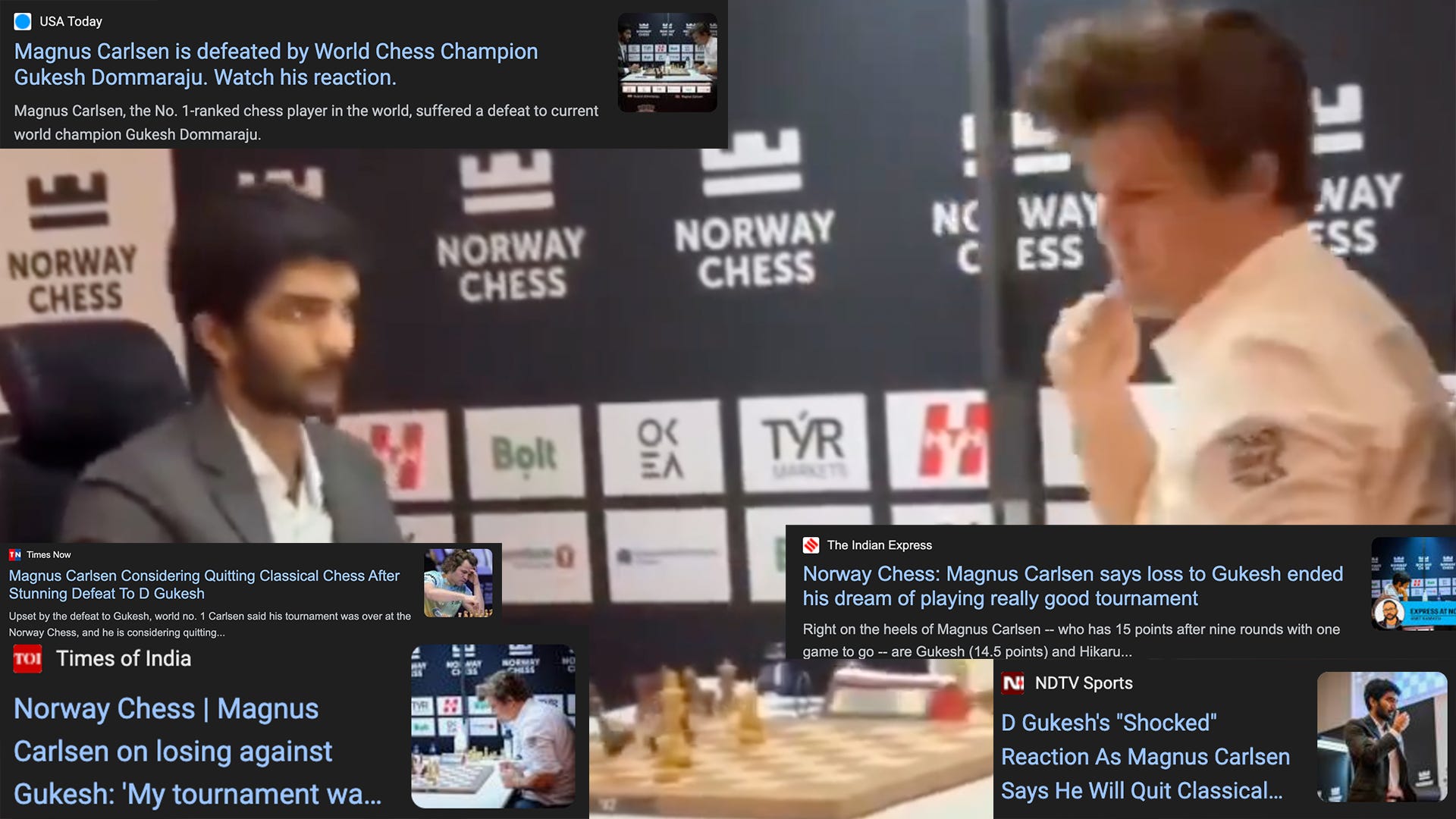
This past weekend, Magnus Carlsen—the highest-rated chess payer in history—lost a classic match.
Carlsen doesn’t lose classic chess matches often. However, during a game against 19-year-old Gukesh Dommaraju, he made an uncharacteristic mistake, and Gukesh jumped on it, defeating Carlsen in 62 moves.
The moment it happened was as intense as anything in sport.
“99 out of 100 times, I would lose,” an overwhelmed Gukesh said in an interview following the match. “It’s just a lucky day!”
Despite his odds before the match, despite his and Carlsen’s records, despite his odds during the match, Gukesh put himself in a position to win.
Magnus Carlsen was in a commanding lead. He had outplayed Gukesh for much of the game, establishing a near-winning advantage. But instead of resigning or phoning it in, Gukesh held tough.
You never know what’s going to happen. That’s why you play the game.
Increase Your Surface Area for Luck
Whether it’s chess, work, or sport, you give yourself a chance by increasing your surface area for luck. Research shows that peak performance isn’t just about quality; it’s also about quantity. The more you step into the arena, the more your chance of getting lucky grows.
Vincent Van Gogh created two of his most famous paintings, “Starry Night” and “Sunflowers,” just two years before his death, after hundreds of other paintings that went unrecognized. Gukesh may only win that match against Carlsen one out of one hundred times, which is why it’s so important he shows up for the other ninety-nine.
So much of success comes down to this: You can’t control luck, but you can put yourself in a position to receive it, over and over again.
Show up. Show up prepared. Show up prepared and don’t quit when things don’t go perfectly. You never know when you’ll catch your lucky break. But you sure as hell want to be in the game to receive it.
When to Grit versus When to Quit
It’s important to note that gritting it out isn’t always the best path forward. As someone commented when I posted about Gukesh on my social media:
“While all this stuff about Gukesh staying staying in the game is true, it might still be worth it to save the energy you need to survive against (or even beat) someone better than you versus winning all the other fights before and after where your odds are better. There is nothing wrong with resilience, but stories like these are not representative for how it usually turns out, and it doesn’t reflect the amount of people who throw themselves agains the wrong walls over and over.”
This is a valid point, and contains more than a kernel of truth.
But Gukesh is a world champion. He doesn’t have much else to prove. you only get so many shots at beating Magnus in a classical game. Gukesh also understands the probabilities and positions better than anyone. If the game was un-winnable, I suspect he would have resigned.
But it wasn’t. He had a path to victory, and he held on.
When there is no path, yes, sometimes you need to move on. When your energy could be spent elsewhere, yes, sometimes it’s smart to conserve it. But in this case, Gukesh had the path and this was a shot he wanted to take. If those elements aren’t there, then yes, it may make sense to step away.
This can be summarized as the perennial question about when to grit versus when to quit. This instance was about the former. But I’ll be the first to say that all the influencers who only post about “never quitting” and “burning the boats” and “never giving up” lack nuance, and they can be very tiresome.
In real life, it’s often hard to know when to quit versus when to push on. It’s a skill that only comes with experience, and it varies based on context. What’s at stake? What are the costs of quitting. What are the costs of not quitting. How often do you have this chance? When will you have it again?
Magnus’s Reaction, In Brief
Magnus Carlsen is still legendary. But he is human and capable of mistakes. That doesn’t take away from his legacy.
I loved the moment of visible frustration as he realized his error and lost. He pounded his fist on the table before standing up to leave. But despite his disappointment and anger, he stopped himself, turned around, and acknowledged and congratulated his opponent.
That was great, too.
In the end, you don’t get to win if you don’t show up. You can’t pre-determine that you’re not going to win because of your opponents’ reputation, or even how things are going once the game starts.
The willingness to show up—day in, day out—is its own accomplishment.
Gukesh earned that win. Carlsen accepted the loss, and will win many matches yet.
Both are examples of true mastery.