

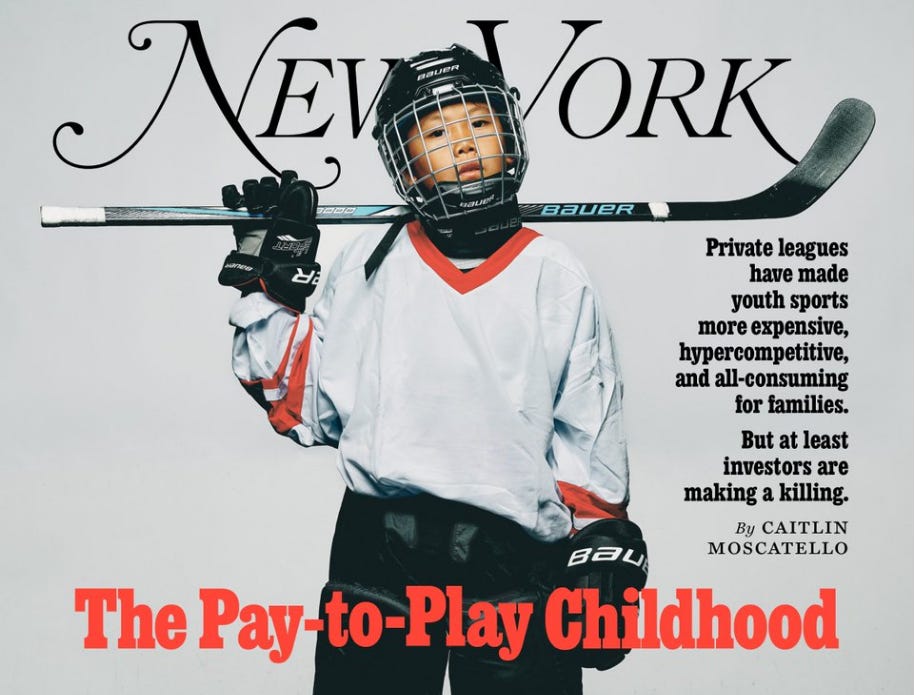
Last weekend: New York Magazine’s cover story was all about how private equity (PE) firms are buying up youth sports leagues, raising the stakes for even the youngest kids, and pricing out, if not ruining, families. Youth sports generate up to $40B in annual revenue—nearly twice that of the NFL. Middle-class families are spending up to $25K a year per child. This is insane.
Also last weekend: my 8-year-old son played in a baseball tournament and had a wonderful experience. The time between the games was the best. He was with his friends. Playing outside. No screens. No helicopter parenting. Just kids running around.
When we got home, he asked, “Can we do another tournament next weekend?”
“I’m not sure,” I responded. “Why?”
“Because I want to do this every day,” he said.
***
Herein lies the conundrum. On the one hand, youth sports in America really are a disaster. According to the American Academy of Pediatrics, 70% of kids drop out by age 131. There’s crying. There’s yelling. There are thousands of dollars spent.
“Parents find themselves trapped,” writes Caitlin Moscatello. “They know the benefits of sports—better health outcomes, higher self-esteem—and want that for their children, yet giving it to them often means buying into a sports ecosystem that is inherently flawed. As the pay-to-play model increasingly takes hold, so does the idea that kids should start competing at younger and younger ages, risking their sense of self along with their shoulders and ACLs.”
On the other hand, youth sports are more important than ever. They offer a desperately needed alternative to the screen-based childhood, and they are an excellent venue for teaching kids the value of doing hard things, how to overcome failure, and how to forge relationships.
When done right, youth sports help with everything from building genuine confidence to developing a good relationship with one’s body. When done wrong, things go sideways fast.
Private equity (PE) firms buying up youth sports leagues is troubling. Their incentive isn’t to build skills; it’s not the physical or emotional health of kids, or the community. It is to make money.
Fees go up. Parents get FOMO. Many of the same families who would have been playing for $100 bucks in a community league now must pay a fortune.
I don’t mind capitalism (because all the other systems are worse). And yet, there are certain industries—health care and education, for example—where profit incentives don’t make sense for anyone other than those making the profits. Youth sports are one such industry.
A youth sports poem:
The more money parents pay,
the more invested they feel,
the crazier they get,
the more likely their kids burn out.
But youth sports can also be excellent. The best.
You get to teach character. You get to teach winning. You get to teach losing. You get to teach effort. You get to teach teamwork. You get to face adversity. Kids learn they take on challenges, struggle, and improve. These are crucial life skills.
So much of youth sports comes down to coaching and parents.
Are the coaches doing it for their own egos or because they love the game and they love the kids?
Do all the parents think their kids are going to get D1 scholarships, or are they hoping their kids make friends, gain confidence, and build character?
Are you playing in a PE-based league that has restrictions on what hotels you can stay at and whether or not you can film your kid, or are you doing it on your terms?
What’s fascinating is that the vast majority of psycho parents and psycho coaches have never played or been around sport at a high level themselves. Those who have understand that the goal of youth sports is not to win a 10-U championship. It is for kids to have fun, learn, develop growth mindsets, build friendships, and want to come back and play again next year.
Regularly check whatever you are doing against these goals.
Make sure the kid wants to play, not you (the parent).
If you are going to travel, set constraints.
Do not specialize in a single sport before high school.
Make sure the coaching is about developing not just good athletes but also good people.
This issue has become personal for me. My latest book has taken off amongst coaches and parents at all levels. I coach three sports. My son and daughter both play.
Most of us can’t change structural forces or outbid PE firms. But we can do our best to parent and coach in the right way. And if enough parents say no to the craziness, then eventually, the craziness becomes less crazy. At the very least, you can protect your own kid and community.
If you’re worried your kid is going to fall behind, that’s a valid concern. I’ve felt it myself. However, you also need to worry about your kid burning out or tying their entire self-worth to performance in sport, and those risks are every bit, if not more, likely. And though I hate to be the bearer of bad news, when it comes to D1 scholarships, genetics and raw talent matter more than we like to admit.
My work has been profiled in The Athletic. I’ve worked with NBA, NHL, MLB, and NFL teams. And yet, one of my biggest challenges is trying to get youth sports right—as a coach and as a parent. It’s not easy, at least given the system we have in America.
But we’ve got to be up for the challenge.
Making youth sports better starts and ends with adults. Set a good example. Be about a growth mindset. Be about trying hard. Be about having fun.
This number is contested, and its primary source is hard to find.
Can I ❤️ about 10X? Too familiar a story underneath all of this:
A kid starts playing because the game is fun. Adults notice ability. Recreation becomes travel, travel becomes year-round, weekends disappear, money pours in, and somewhere along the way the child’s game becomes an adult project. Typically associated with the unlived life of the parent(s).
Then we wonder why so many kids walk away. The tragedy is that while competition can teach extraordinary things, we professionalized childhood before children had the chance to discover whether they actually loved the game.
We took something that could teach failure, friendship, courage and joy, and turned it into another résumé line…
Nicely done Brad. Change starts with thoughtful reflection like this. 🙏🏼