

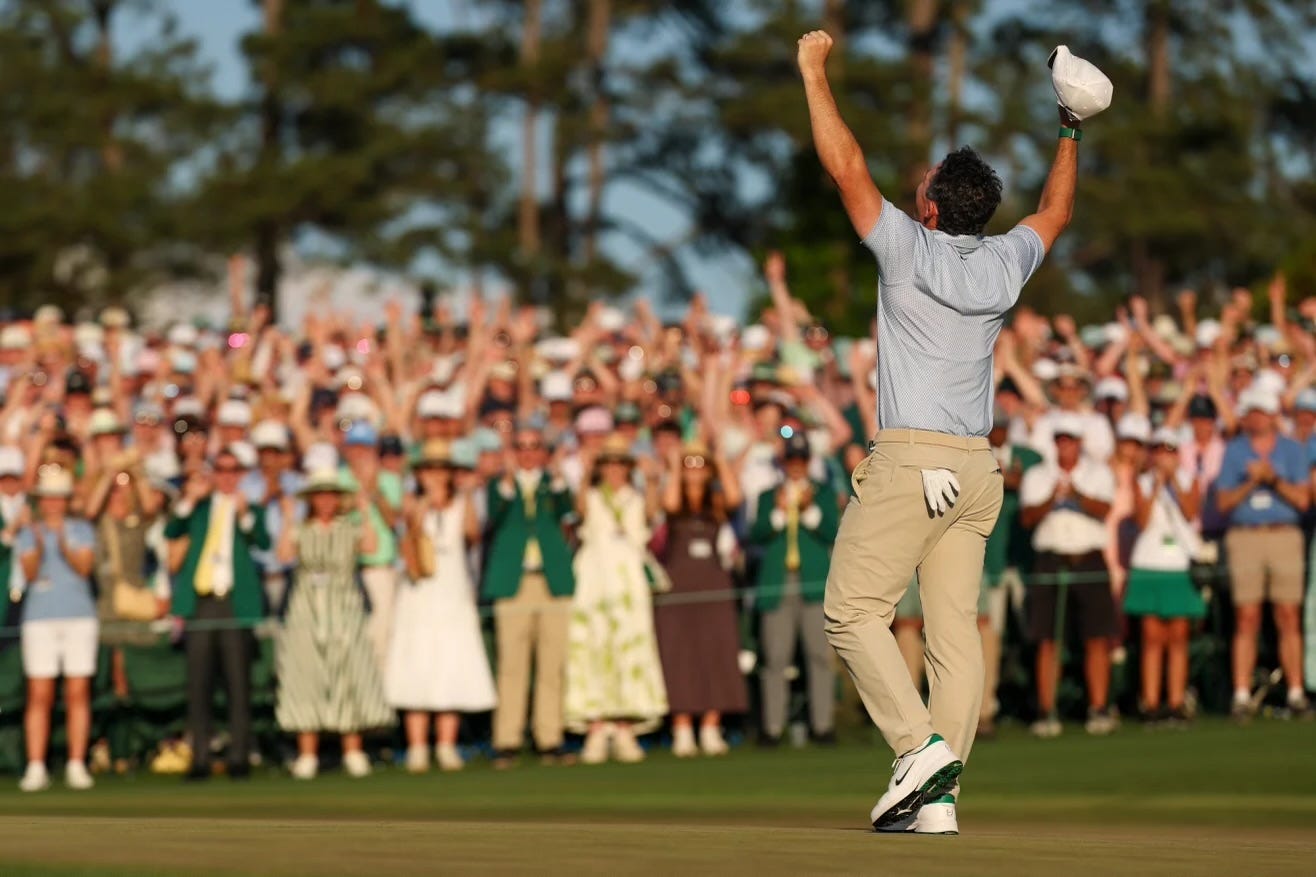
When shots are falling—focus on the process.
When shots aren’t falling—focus on the process.
So much of success comes down to showing up, weathering storms, staying in the moment, trusting your training, and making the next best shot.
In golf. In sport. In life.
After last year’s roller coaster victory at the Masters, Rory McIlroy came out in the 2026 version firing on all cylinders. After 36 holes, he led by 6 strokes, the biggest margin at that juncture in 90 years of tournament history. It appeared as if he’d finally put his doubts and limits and ghosts behind him. He was taking big swings and playing to win. It was a joy to watch.
But then, on day three, he played a terrible round that included 3 bogeys and a double bogey. His entire lead was erased. He entered the final round tied for first place with an extremely tight race behind him, including many of the best players in the world.
McIlroy began the final round with more erratic play and by hole six was multiple shots back. As a big fan of McIlroy, it was genuinely hard to watch.
And yet, throughout it all, McIlroy stayed calm and collected. No thrown clubs. No screaming or shouting. No poor body language. Just a relentless focus on the next shot—whether it was from the sand, wood chips, gallery, behind a tree, or whatever other predicament he found himself in.
He hung in there. He stopped the descent. He prevented his bad holes from becoming awful holes. And then, stroke by stroke, he slowly began to turn things around. He started making pars and reclaimed the lead on 11. He made birdies on 12 and 13 to go up two shots. He never looked back. The rest is history.
McIlroy won the Masters for the second year in a row, becoming only the fourth golfer ever to do so, along with legends Nick Faldo, Tiger Woods, Jack Nicklaus.
“One of the things that I love is focusing on the process over the prize... I would say to myself a lot: ‘Process over prize. Process over prize. Process over prize, just to take myself away from the outcome,” McIlroy says. “I can get real caught up in the outcome. I just really need to remind myself that the outcome will ultimately happen if you just focus on the process. It takes care of itself.”
McIlroy’s instinct is backed by research.
Multiple studies find that those who focus on outcomes—winning, rankings, scores—experience more anxiety and reduced engagement. People who focus on the process—technique, the next action, what’s in their control—perform better under pressure.
The reason is that outcome goals activate threat responses in the brain. Process goals keep you in the present moment. Researchers call it the difference between a threat response (scared and doubtful) and a challenge response (revved up and ready for the next action).
What’s true in golf is true in life
Anyone can show up when everything is clicking. But things will inevitably go wrong. You’ll make a great effort and still fall short. The winds will blow one way, then another. You’ll face moments where your emotions flare and things fall apart.
What matters most isn’t the adversity. It’s how you respond. Again and again and again.
There’s a reason so few people repeat at the Masters. There are so many variables. It is so hard to stay focused and play to win with history riding on the line. When you think you’ve got it in the bag, you’re almost always wrong.
In today’s final round, there were four different leaders and every single one fell off, except for one: Rory McIlroy, who maintained his lead for the last 9 holes.
It’s not that outcomes don’t matter. (They do.)
It’s that what gives you the best shot at achieving your goals is focusing on the process and digging where your feet are. When you focus on the process you put the shot that could have been or should have been or might have been behind you. You play where you are. Which is the best way to play.
You can’t just call upon a process mindset when you are down three strokes on the final day of the biggest golf tournament in the world and expect it to work. It needs to be an ongoing practice.
We cannot control how someone receives our work, the weather on the day of the big event, the judge’s mood during a competition, or all manner of other factors that impact outcomes, in work and life. Sometimes we do everything right and the outcome still doesn’t go our way, even in spite of our deepest desires. All we can control is our process. How we show up in the next moment. The next action we take.
People often think excellence is about control or perfection. But that couldn’t be further from the truth.
Excellence is about stepping into the arena. Caring deeply. Giving your all. Beginning again. Responding instead of reacting. Laying it all on the line. Falling short. Bouncing back. Exceeding expectations.
It’s doing all this while staying firmly grounded in the process, which means trusting your training, showing up, and meeting the moment.
Thanks for reading. If you found this resonant, you’ll love my new book The Way of Excellence. Parts of this post were excerpted from it. The book goes deep into the science and practice of a process mindset, and how to cultivate one yourself.
Excellent example of fortitude in a clutch. Persistence pays off.
Brad, I don’t think you are a cycling fan, but if there was ever an athlete I think you’d admire it is Wout van Aert and his win today made grown men cry tears of joy all over the world. If you've got the time Caley over at Escape Collective summed up his thoughts quite well: https://escapecollective.com/the-tides-of-wout/?gift-token=Yuf6NhRK