

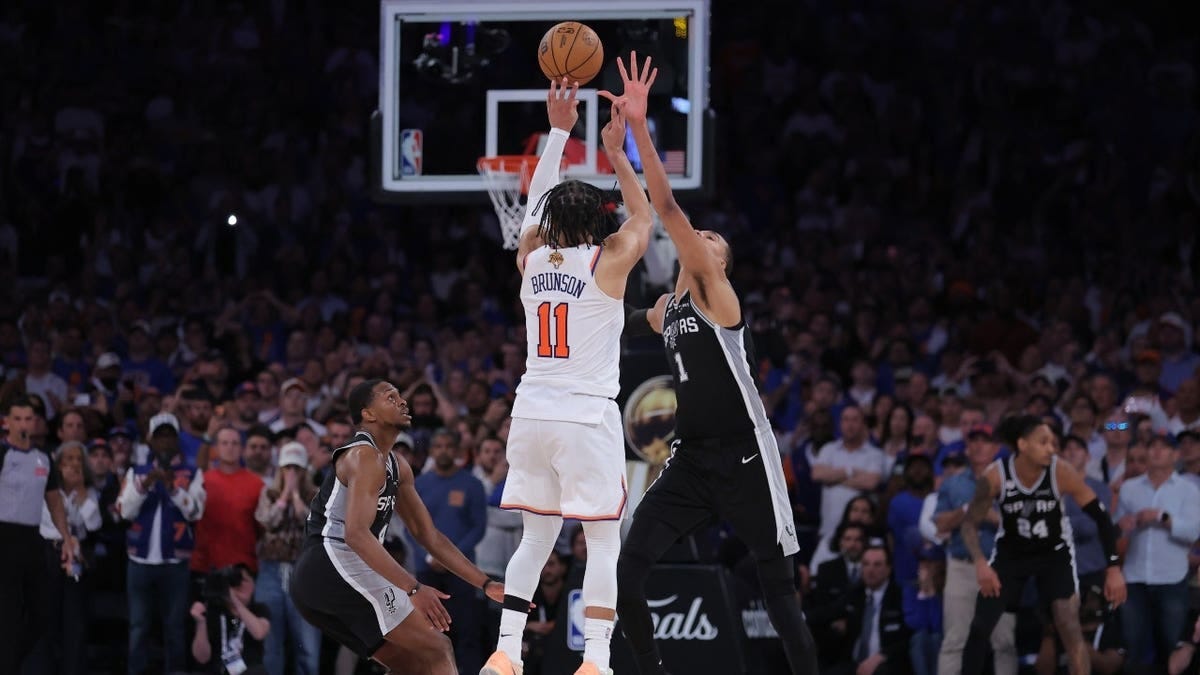
In the moments after the New York Knicks improbable NBA Championship, their star guard, Jalen Brunson, was asked how he took over in the clutch.
His response: “My confidence comes from my work ethic.”
“Never be afraid to fail,” Brunson said earlier in the day. “You put the confidence in everything you do when the lights are on because of everything you’ve done when no one’s watching.”
Everyone is sending me these quotes and asking if Brunson read The Way of Excellence. I have no idea, but he’s a perfect ambassador for the book. He embodies what I mean when I write that confidence comes from evidence, and that in order to gain evidence, you’ve got to be willing to fail.
We live in a world of affirmations, manifesting, and belief that often borders on fantasy. The most popular self-help podcast hosts suggest that if you just wake up, look in the mirror, think positive thoughts, and say you can do it—then, well, you can do it.
Unfortunately this is bullshit.
The way you gain confidence, be it on the basketball court, in creative pursuits, as a leader, in relationships, as a parent, is through experience, through evidence. It’s not to say that self-belief isn’t important. (It is.) But it’s only as powerful as the reasons you give yourself to believe it.
The catch is that evidence isn't free. You only get it by putting yourself in positions where you might fail. If you are pushing yourself and taking risks, then it is inevitable that sometimes you will come up short. The inverse is also true. If you are scared to fail, then you will never push yourself or take risks. The virtuous cycle is getting comfortable with failure, putting yourself out there, amassing evidence, and gaining confidence. The vicious cycle is being terrified of failure, playing it safe, staying on the sidelines, facing overwhelming doubt.
Every area of my life where I have some degree of confidence followed a ton of work and a ton of failure. My writing has been rejected more times than I can count. My first serious relationship ended in heartbreak. I’ve missed more PR attempts in the weight room than I’ve made. I was terrified of becoming a parent but we did it anyway. Gaining confidence wasn’t a matter of days, weeks, or months. It took years, even decades.
One of my friends is a renowned surgeon. “Ninety-five percent of the time in the OR [operating room] things go smoothly,” he once told me. “But the other five percent, when the unexpected happens and you have to control excessive bleeding, change your plan when an implant fails, or fix an injury that is more severe than anticipated. I live for that. It allows me to bring all my years of training and experience to meet the moment.”
His confidence is based on evidence and years of deliberate practice and experience.
“When we are in training with our mentors it is great to see the cases that are effortless and learn the steps of how things should be done, but the ones the trainee appreciates the most are the cases that don’t go well because then we see the masters at their best and in turn learn for ourselves how to deal with those complex situations in the future,” he continued. “The most valuable cases that I saw in my training were the ones that went sideways and the best surgeons remained calm and knew how to get out of trouble.”
The ability to face challenges is a core element of what psychologists call self-efficacy: an evidence-based belief that you are capable of showing up and excelling in highly charged circumstances.
Decades of research show that individuals who score high on measures of self-efficacy are better able to work through the inevitable moments when they feel lost or stuck, be it in the operating room, on the playing field, when facing the blank page, or in the boardroom. If you are insecure about your process and abilities, then you’re liable to catastrophize when the path forward is unclear. But if you are secure about your process and abilities, if you have evidence to lean on, then not much can faze you. The best way to gain self-efficacy, the research shows, is through experience.
There are no shortcuts, secrets, or laws of attraction. There is only putting in the reps. Shoot the 500 daily jump shots. Write the bad first draft. Study the greats. Change the diaper. Ask your crush out. Apprentice with a master. Reps. Reps. Reps. Confidence is really just doing the work and then having the faith to trust it.
Behind every game-winning jump shot, bestselling book, outstanding performance, comfortable relationship, or really anything good in life is a messy body of evidence. You don’t see it on social media, but it’s there. You’ve got to give yourself the permission and space to experiment, learn, fail, and ultimately grow.
In a 1987 interview for her popular daytime show Mavis on 4, Mavis Nicholson asked the poet and activist Maya Angelou how she arrived at her commanding confidence on stage. “I know theater. I write for it. I have studied it. I act for it now and again. So I know theater. And I am centered,” explained Angelou.
Earlier this year Sebastian Sawe became the first human ever to run under 2-hours in a sanctioned marathon. The morning after he broke the record, I received the following note from his coach: “confidence based on evidence has been a guiding principle in the days leading up to the race.” The reason Sawe was comfortable going out at a historic pace on race day is because he’d put in years of training that proved to him he had a shot.
Sawe’s approach is no different from Angelou’s is no different from Brunson’s. Their robust confidence comes from their robust evidence.
The same is true for all of us. The key to confidence is evidence. And the only way you gain evidence is by getting over your fear of failure and doing the work, over and over again.
This is so beautiful, and the same principle applies not only to confidence but also to self-respect.
The way we become a person we respect, love, and value is by proving to ourselves every day in mostly small but occasionally big ways that we are a person who deserves respect, love, and value.
It's standing up for yourself when you're being mistreated. It's voicing your concern in a meeting when you feel more comfortable staying quiet. It's choosing the healthier meal instead of the unhealthy one. All of these relatively small choices create the evidence that we are a person who deserves respect.
Anyways, great article—I'm looking forward to reading your book!
I don't disagree, but I do think there is some nuance. I think of Khabib's quote, "You have to think of yourself as the best fighter in the world. The first person who can believe in you is you. After that, it can be your coach, parents, etc”... he goes on to say that is the only way you can succeed, because the pressure and stakes are so high. He does also commonly reference humility as well, "Sometimes when people become... 'I'm this, I can do this. I'm smart because I'm strong.' God always going to make you humble."...which makes me think of balance, or probably closer paradox, holding both beliefs in your head to the max. I also think of Williams James' overbelief.